
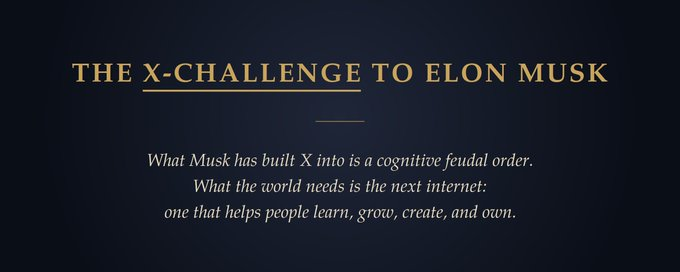
In 2022, Elon Musk paid $44 billion for Twitter. Today it is called X.
X runs on a scoring sheet that decides what more than a hundred million people see every day.
On that sheet, the time you spend reading an article you clicked on is worth zero.
A reply, even an insult, is worth five.
This is not speculation. It is written, in plain numbers, in the code X has made public.
Behind that sheet lies a promise made four years ago, and an outcome almost no one has noticed.
A revolution
In late October 2022, Musk closed the deal.
Days later, on November 1, he announced that he would abolish a feudal order.
He meant Twitter's blue checkmark. In those days it was granted to celebrities, journalists, and institutions. Ordinary users could not have one.
Musk called it a "lords & peasants system."
His remedy: "Power to the people!"
From now on, anyone could have the checkmark for eight dollars a month. And those who paid would rank higher in replies, mentions, and search.
Remember that last sentence. The rest of the story turns on it.
Two checkmarks, two meanings
Other platforms verify accounts, too. WeChat, China's all-purpose messaging and publishing app, lets its Official Accounts, including individuals, apply for a verification mark.
According to WeChat, the mark exists to confirm that an account is who it says it is, and to unlock additional features. It certifies identity.
X's paid checkmark, by its own description, sells something else: a place ahead of others in the conversation.
One tells you who someone is. The other sells where someone stands.
The difference looks small. It is not. It decides whether a platform becomes a public square where everyone stands level, or a ladder of ranks.
The fate of an essay
The clearest way to understand X's design is to follow a single piece of writing through it.
Imagine a writer. A serious scholar, with a dozen followers on X.
She has written a long essay on one of the defining questions of the age of AI. It takes twenty minutes to read and several days to absorb.
She presses publish.
What happens next is not luck. Every step is written into the code. The figures below come from the production parameters X published, as synced on August 12, 2026.
Step one: entry.
X's feed draws on two sources: recent posts from accounts you follow, and posts from strangers that a model predicts will engage you.
With a dozen followers, the first source is nearly empty. Her essay must travel by the second.
And on that road, it starts with a penalty. When a reader does not follow the writer, the post's score is multiplied by 0.75: a quarter of it, gone.
When the system surfaces a post to outsiders by topic, the score is cut in half.
Yet the most natural readers of an essay on AI are precisely those who follow the topic and have never heard of the writer.
A lower score means a lower rank. A lower rank means the essay rarely reaches anyone's eyes.
Step two: scoring.
Think of the system as an examiner. It predicts how each reader will react to the essay, then awards points for each reaction.
Here is the full scoring sheet:
A predicted reply: 5 points.
A quote-post: 5.
A like: 0.5.
Opening a link: 0.2.
The continuous time spent reading after clicking through: 0.
The real system is more intricate than any sheet. But the weights show what it values.
Her essay is careful, not combative. It will rarely earn the five points of a reply.
What she most wants from a reader is that he read it through. That is exactly the line that scores zero.
Step three: the lift.
In fairness, the code leaves newcomers a way in. Accounts with fewer than a thousand followers get a brief boost for posts less than a day old.
She qualifies. But the lift lasts hours, and it is judged by the same sheet: can you provoke a reaction?
Step four: expiry.
Forty-eight hours after publication, the essay is removed from the feed altogether.
A piece that takes days to absorb has a shelf life of two.
Step five: paying.
Suppose she refuses to give up, and decides to pay.
She can subscribe to Premium+, X's top tier, at $40 a month. By X's own description, it buys the "largest reply prioritization" and the right to publish long-form Articles.
X does not merely tolerate long-form writing. It sells the right to publish it.
But look closely at what she has bought: a higher place in the reply threads under other people's posts. A place in line, not a reader.
She can also promote her essay.
On WeChat, paying to boost an ordinary article does not turn it into an advertisement; under WeChat's rules, an advertising label is required only when the boosted content itself is commercial. A boosted essay is still an essay.
On X, paying to promote a post means buying an ad. It appears in strangers' feeds marked "Ad." To the reader, it is an advertisement first and an essay second.
And X measures the result in "views," which it counts this way: any time a post appears on a logged-in user's screen, whether or not anyone reads it. The same person may be counted more than once. The author's own views count, too.
What her money buys, mostly, is the privilege of passing before other people's eyes.
The verdict.
Penalized on entry. Zero for reading. A lift of a few hours. Expired in two days. Money that buys a place in line, an "Ad" label, and a glance.
Her essay's fate was settled before she pressed publish.
This is not one writer's misfortune. It is what awaits anyone on X who writes seriously and lacks a large following.
It is not an accident. It is the sum at the bottom of that scoring sheet.
The inheritance of attention
On X, whether an essay is seen depends first not on how good it is, but on how much attention its author already has: how many followers, how much past engagement.
X also computes a score for every account, using a variant of PageRank, the algorithm Google made famous, and that score feeds the systems that decide what may be seen.
Every post, as it is published, is classified by AI systems whose prompts X has chosen not to publish.
Call what is being allocated here cognitive standing: the right of a thought to be weighed by another human mind before it is dismissed.
On X, that standing is largely inherited. Yesterday's attention decides today's.
In 1968, the sociologist Robert Merton gave this pattern a name. Studying how scientists receive credit, he found that the famous get more recognition for the same work than the unknown. He called it the Matthew effect, after the Gospel: "For unto every one that hath shall be given."
Merton described a tendency of human institutions. X has written it into code.
Even the lords worry about their rank.
In February 2023, according to the tech newsletter Platformer, Musk was displeased that a Super Bowl post of his drew fewer views than one by President Biden, and demanded a fix.
Engineers changed the code so that his posts bypassed the ranking system and went straight to the top of users' feeds.
When the highest lord found his reach wanting, the remedy was not to reform the order. It was to cut himself a private gate.
For everyone else, the way up is not entirely closed. But it measures not how deeply you think, but how many reactions you can draw.
A careful rebuttal is a reply. An insult is a reply. They score the same.
Reading an essay through and thinking about it for an hour scores nothing.
This is not a reward for critical thinking. Critical thinking begins with careful reading, and careful reading is the one thing the sheet does not count.
The purchased title
So what does money buy?
In 1611, King James I, short of funds, invented a new rank, the baronet, and sold it. Buyers received a hereditary title. They did not receive a seat in the House of Lords.
X sells the same thing. Premium buys the checkmark and priority in replies. Premium+ buys the largest priority of all. A title, not a seat. A place in line, not a reader.
The seats are reserved for those who already have vassals. To sell subscriptions on X, a creator needs at least 2,000 verified followers, meaning followers who themselves pay the platform, and five million organic impressions in three months.
In March 2024, Musk announced that accounts with more than 2,500 verified subscriber followers would receive Premium free, and those with more than 5,000 would receive Premium+.
The peasants pay for their titles. The lords with enough paying vassals receive theirs as a gift.
Capital can buy the title. It cannot buy its way into the order.
The town square
Now the story comes together.
Musk said the old Twitter was a lords-and-peasants system, and he would overthrow it.
What replaced it is another hierarchy: rank conferred for reaction, and also for sale; the higher your rank, the more privileges you receive, many of them free.
The man who named the lords-and-peasants system went on to rebuild it.
The irony deepens. X still describes its mission as being "the town square of the internet," a place where anyone can share ideas at once, with no barrier in between.
Months before the purchase closed, Musk told Twitter's employees that it should become as all-encompassing as WeChat.
The image is more revealing than intended.
In medieval Europe, the town was where feudalism began to end. In many towns, a custom later summed up as Stadtluft macht frei, "city air makes you free," held that a serf who lived there for a year and a day could no longer be claimed by his lord.
In the town square, people gained standing by what they made and traded, not by whom they served.
That is a square.
X calls itself a town square. It has built a manor, with every rank in its place and an invisible wall around it.
The economist Yanis Varoufakis has called the platform economy "technofeudalism," a regime in which platforms collect rent like lords.
X's feudal order goes further. It is not only economic. It is cognitive. It decides not merely who earns money, but whose thoughts deserve to be read.
More lasting than bronze
Two thousand years ago, the Roman poet Horace closed a book of odes with a boast: he had built a monument more lasting than bronze.
He meant his writing. He was right.
Why can writing outlast bronze? Because it is more than a record. It is the technology through which humanity learned to think about its own thinking.
Write an idea down, and you can stop, return, and ask whether the argument holds. So can your reader. That capacity has a name: metacognition.
X's scoring sheet gives it almost no weight. It rewards reaction and taxes reflection.
Horace promised his writing would outlast bronze. X gives it only forty-eight hours.
There is a quieter conservatism, too. X's model predicts what you will do from what you have done.
But a genuinely new idea is, almost by definition, one that resembles nothing you have encountered before.
A system that ranks the present by the past cannot recognize the future when it arrives.
Circles in the desert
Musk and his engineers are among the most brilliant people of our time. How did they spend $44 billion to rebuild an ancient order?
Most likely not by design. By walking in circles.
In 2009, scientists at Germany's Max Planck Institute asked volunteers to walk in a straight line for hours, in the Sahara and in a German forest, and tracked them by GPS.
When the sun or moon was visible, most walked remarkably straight. When clouds hid the sun, the walkers in the forest began to circle, without noticing.
Blindfolded walkers traced circles sometimes less than twenty meters across. Shown their tracks afterward, they could hardly believe them.
The problem was not their legs. It was the absence of an outside reference.
X's only reference is itself. Past reactions predict future reactions, which become the basis of the next prediction.
It is like two mirrors facing each other.
The algorithm shows users what their past behavior predicts; users like, reply, and post in response to what the algorithm shows them.
The two mirrors reflect each other: a mirror within a mirror, within a mirror, receding endlessly.
However many reflections there are, the mirrors show only themselves.
There is no window through which light from outside can enter.
X is not blind to its own errors. Its code includes an elaborate "dwell regret" model, built to estimate whether users regret the time they spent.
The organizational theorist Chris Argyris of Harvard illustrated the problem with a thermostat.
Set it to 68 degrees. When the room cools, it heats; when it warms, it stops. It does its job well. Argyris called this single-loop learning.
But the thermostat never asks whether 68 degrees is the right temperature. Only a system that can ask that question is capable of double-loop learning.
X is an extraordinarily precise thermostat. It tunes reaction ever more finely, and never asks whether reaction is the right thing to pursue.
In January of this year, when X made its algorithm public, Musk himself said it "sucks" and was "dumb," and promised improvements every month.
But what is being improved: the thermostat's precision, or its setting?
And we circle with it. Every like, every reply, becomes a signal the machine learns from, making it better at the only game it knows.
Over time, those who came to think tend to drift away, and those who came to fight tend to stay and grow better at it.
Intelligence tells you how to walk faster. Metacognition asks whether you are walking in a circle.
The other side of the ledger
Fairness requires the full accounting.
X publishes its code, a degree of transparency few rivals match. Without it, this essay could not have been written.
It dampens repeated posts from a single author and reranks for diversity.
Its Community Notes feature shows a correction only when people who usually disagree both rate it helpful. It is among the most genuinely democratic mechanisms on the internet.
And one detail is striking: the highest positive weight in X's scoring sheet, 20 points, belongs to a reader copying a post's link to share it elsewhere.
That is precisely how writing spreads on WeChat.
X knows that a reader's decision to pass something on is the most valuable signal of all. A serious essay simply rarely lives long enough on X to receive it.
If the essay were published on WeChat
Now place the same writer and the same essay on a WeChat Official Account.
WeChat's publishing platform has a slogan: even the smallest individual can have a brand of its own.
WeChat counts "reads": one each time a person decides to open the article. It counts choices, not passings.
WeChat sells reach, too. Its promotion tools are aimed at "reads" or "follows." What money buys there is a chance to be chosen.
Whether a reader then shares the article with others is not for sale. Only the reader decides.
An article spreads on WeChat, to a large degree, because one stranger after another judges that it is worth passing on.
WeChat is no perfect square. It has its own walls and gatekeepers, and its recommendation algorithms are not public either.
But in the one respect this essay is about, how writing earns its way to a stranger, its design behaves more like a square than X's.
The reckoning
You may wonder why any of this matters beyond a comparison of platforms.
It matters because AI has arrived.
AI has made knowing nearly free. Much of what once made us seem learned and insightful is being exposed for what it often was: retrieval plus memory.
Beliefs that cannot withstand scrutiny, positions held out of emotion, the untested sense that "I understand," once passed unnoticed. Now they are being marked down, one by one, like bad assets.
This is the cognitive reckoning.
What survives it are different capacities: the ability to ask a good question; to know what you do not know; to use AI as an amplifier rather than a substitute; to hold sound judgment amid noise.
Now hold that list against X's scoring sheet.
Asking a good question: zero. Admitting uncertainty: zero. Thinking before you speak: zero.
An angry reply: five.
The reckoning should clear cognitive debts off the books. X is awarding them titles.
Once, people preserved their cognitive advantage through status, credentials, and circles. In the age of AI, all of that ought to be repriced. X's inherited standing does the opposite: it shields the old order from the reckoning in a new form.
A professor's title earns no readers on X, and it shouldn't; credentials ought not convert into attention. The problem is what X prices instead. Not thought, but reaction.
And reaction is exactly what AI can counterfeit at scale. When bots can reply, repost, and like without limit, titles conferred for reaction will lose their value like debased coin.
The reckoning will climb the ladder of ranks, rung by rung.
No one will escape it.
WeChat faces a different test. When AI-written articles flood its platform, will readers' choices be drowned? Will the smallest individual still be found?
The next social network
Someone may say: then build a better long-form platform.
But long-form platforms are not scarce. The English-speaking world has Substack and Medium.
The real question lies deeper: what kind of relationship is today's social network built on?
In 2023, The X-Challenges posed a deceptively simple problem.
Among five people, if each pair can only be connected or not, there are 1,024 possible configurations of relationships.
Give the relationships direction, who learns from whom, who helps whom, and the configurations among those same five people become 59,049: nearly sixty times as many.
Add more people, a teacher and a classroom of eighteen students, say, and the number grows beyond anything a teacher could ever manage.
Of course, if students are expected only to listen to the teacher, one teacher can manage a great many. But that is another matter.
The internet of the past three decades was built on the first kind of relationship: who follows whom, who is friends with whom.
It has relationships, but they have no direction and no value, except as a way to capture attention and sell it to advertisers.
X takes this model to its extreme. It does not give relationships direction or value; it sells them. The attention they generate is packaged for advertisers. The rank within them is priced for subscribers. A relationship is worth only as much reaction as it can provoke.
The next social network will reverse this. It will not sell relationships; it will give them direction and value. It will be built on the second kind: learning relationships with direction and purpose.
When one person reads another's essay, or uses someone else's solution, and genuinely learns something, that is a directed relationship. When he passes it to a third, the relationship extends.
In such a network, how far an idea travels depends on how many real learning relationships it creates, not on how many followers its author already has.
Here AI's role reverses.
In the vast web no teacher could manage, AI, guided by each person's cognitive development, can help them find the few relationships truly worth forming.
On X, AI belongs solely to the platform, and it predicts and amplifies reaction.
In the next social network, AI owned by individuals and families, serving their own learning and cognitive growth, can become a navigator of learning relationships, like the sun in the desert.
The principles are not mysterious:
Make cognitive assets, not posts, the unit.
A cognitive asset is what a person has thought, learned, or created: an essay, a solution, a work, a genuinely productive act of learning.
Count what a reader chose, not what passed before his eyes.
Let distribution be decided by those who have read and learned, not by those who merely reacted.
Let an idea live until its value has been fully taken up, not for a few hours, a few days, or a few weeks.
And remember whose assets they are.
On X, every like is unpaid labor feeding the machine, and every essay is inventory, discarded after two days.
The next social network must reverse both: standing earned by being read and learned from, and cognitive assets owned by those who create them.
The X-Challenges calls this cognitive sovereignty.
The gap between AI and people
Every major platform is now putting AI in front of everyone.
In March, Tencent launched WorkBuddy, an AI workstation that does the work for you; its enterprise edition is sold as a team of "digital employees."
In September, Meta introduced Muse, a personal AI agent that Zuckerberg called the centerpiece of Meta's vision.
ByteDance has Doubao. Musk has Grok, built right into X.
They are powerful. They can draft documents, book flights, build reports, manage calendars.
Yet between these AIs and each actual person lies a gap.
The gap is not technical. It is in the underlying logic: whose AI is it, and whom does it serve?
The model belongs to the company. It runs on the company's machines and is priced on the company's terms.
WorkBuddy is billed in credits and sold to employers as efficiency.
Muse lives in a "secure virtual machine" that Meta provisions for each user, but the machine is still Meta's.
By default, X users' posts are used to train Grok, and Musk's AI models, in turn, rank X's feed.
They will work for you. They will not grow with you.
When a task is done, the relationship ends. What you learned with it, what you created, whom you helped: that record stays with the platform, not with you.
This is selling relationships again, in a cleverer form. The platforms once managed the relationships between people. Now they are using AI to manage those relationships, and beginning to manage the relationships between people and AI as well.
In fairness, change is under way. Meta lets users opt out of having their conversations used to train its models, and it has released an open model that runs on a person's own device. These are steps in the right direction.
But for the direction to truly change, the underlying question must be answered: who owns the AI?
As long as AI belongs to the platform, its direction will be set by the platform's metrics: retention, time spent, efficiency, advertising.
Only when AI belongs to individuals and families can its direction be set by a person's own growth.
This is where The X-Challenges' idea of cognitive sovereignty lands in the age of AI.
There is a larger question almost no one is asking.
AI has two faces.
One does the work: drafting documents, building reports, generating articles and videos, fast and in volume.
The other is conducting an audit: the cognitive reckoning described earlier. It makes knowing nearly free, and marks down, one by one, whatever cannot withstand scrutiny.
The two faces are one process. The more AI produces, the more thorough the reckoning. When anyone can generate a report or an essay in a minute, the report or essay itself is no longer worth much.
Today, every company's AI is racing in the same direction: how to do people's work better.
But what happens once the work is done?
When every person and every company has an AI working for them, a flood of output will pour out, and be marked down just as fast.
Then what is scarce will no longer be the ability to do the work. It will be three things: Which of it has real value? Who has truly learned from it? And who owns it?
No AI tool can answer these questions on its own. They require a new internet.
The direction
AI is shaking more than social media. It is shaking the foundation of the internet's business model.
For two decades, social media has worked like this:
Users create content and build relationships with one another. Users and advertisers pay for reach.
The platform sells those relationships, packaging the attention they generate for advertisers, and passing a small share of the revenue to its most prolific creators.
The content comes from users. The relationships come from users. The attention comes from users. The money goes, mostly, to the platform.
The business rests on two pillars. The first: content worth seeing has to be written by people, one piece at a time. The second: behind every view, like, and share is a person. Advertisers pay because they believe real people are watching.
AI is removing both pillars at once.
The marginal cost of generating text, images, and video is approaching zero. Content no longer needs a person to write it.
Views, likes, and replies can be manufactured by machines at scale. Advertisers can no longer be sure whether a person or a machine is on the other side of the screen.
When content no longer requires a person, and a like no longer proves anyone is watching, the business of selling attention loses its foundation.
A cognitive feudal order that ranks people by likes, replies, and reposts will be the first to fall: the very things it ranks by are the easiest for machines to fake.
Where will value, and the underlying logic, go?
To what machines find hardest to replace or fake: the judgments and creations of real people, in real learning relationships.
In other words, cognitive assets.
Picture it.
A high school student writes a research report from a project on the river in her hometown. Five strangers read it through. One, a teacher in another city, builds a lesson around it. Another, an environmental engineer, uses its method to test the river in his own town.
On today's social networks, the record reads: five views, zero likes.
On the next, it reads: two real learning relationships.
That student now owns her first cognitive asset.
The business of the next internet will not be selling relationships or reselling attention. It will be giving relationships direction and value, and helping each person build, prove, and own cognitive assets: what they have learned, what they have created, whom they have helped, and who has truly learned from them.
The platform's role will change with it: from a lord who decides who deserves to be seen, to infrastructure that helps every person be truly seen, so that every real learning relationship can be formed, recorded, and respected.
This is the direction The X-Challenges proposes: from selling relationships to giving them direction and value; from directionless social ties to directed, valuable learning relationships; with cognitive assets as the unit; with cognitive standing earned by being read and learned from; and with cognitive assets owned by those who create them.
The same crossroads
In 2023, The X-Challenges wrote that today's social networks, X, Facebook, YouTube, Instagram, TikTok, LinkedIn, and the rest, stand at a crossroads: embrace this new opportunity, or fade into irrelevance.
Three years later, AI has made the crossroads urgent.
Musk has simply gone furthest. He has already built large AI models into X's ranking system. But there, AI's work is to predict reaction more precisely, to enforce the scoring sheet more completely.
In the wrong direction, the stronger the AI, the faster the circle.
The others stand at the same crossroads.
In May of this year, at Tencent's shareholder meeting, Pony Ma, the company's co-founder, chairman, and chief executive, was asked whether Tencent had fallen behind in AI. He answered with an image: a year earlier, they thought they had boarded the ship, then discovered it was leaking; now they had finally found their footing, but could not yet sit down, and only hoped the ship would go faster.
It was a rare moment of candor.
He added that Tencent would play to its strengths and stay on the right path.
That is the question. In the age of AI, where does the right path for social networks lead?
Pony Ma, Allen Zhang, Zhang Yiming, Mark Zuckerberg: each knows that AI will upend social networking. Each company is investing enormously in AI.
But the competition is mostly over whose models are stronger and whose computing power is greater. Few are asking the deeper question: when AI can generate unlimited content and reactions, what must relationships on a social network become?
However fast the ship, in the wrong direction it only circles the sea.
So this challenge is theirs as well.
To Pony Ma and Allen Zhang, the creator of WeChat: WeChat counts choices today. As AI makes recommendation ever smarter, will WeChat hold on to choice, or slide toward passing? And if it holds on, how?
To Zhang Yiming, founder of ByteDance: Douyin and TikTok have made recommendation more powerful than ever; one tech outlet described X's new algorithm as an upgrade of TikTok's method.
According to an internal TikTok document reported by The New York Times in 2021, its system optimized for two metrics: whether users come back, and how long they stay.
So what does it recommend today: content that makes people stay, or content that helps them grow? And how would we know?
To Mark Zuckerberg: Facebook and Instagram connect billions of people. How many of those connections are real learning relationships?
And finally, back to Musk.
He has long wanted X to become an "everything app," something people cannot do without, as WeChat is.
But an everything app must first make every ordinary person feel it was built for them.
On a ladder of ranks, each rung is narrower than the last, and there is never room for everyone. Those at the bottom can only conclude it was built for those above.
If X's cognitive feudal order does not change, the everything app will remain, most likely, a mirage.
Musk has built rockets that land themselves and electric cars that reshaped an industry. In the world of machines, he has proven himself.
Can he do it once more, in the world of the human mind?
He promised to overthrow the lords-and-peasants system. This time, can he actually do it?
It took the modern world centuries to dismantle feudalism.
It would be a strange tragedy to rebuild it in the one domain the age of AI has made most precious: the human mind.
Who will be the first to build the next social network?
The X-Challenges is ready to lend a hand.
This is the X-Challenge to Elon Musk, and the X-Challenge to every social network of the internet age.
The next time something appears in your feed, ask: Who chose this for me? And with whom has it connected me in a real learning relationship?
— Guoli Liang, Founder, The X-Challenges
—————————
This essay is being published simultaneously on a WeChat Official Account.
Sources
X For You algorithm, public repository: github.com/xai-org/x-algorithm
Production parameters (weights, penalties, small-account lift): github.com/xai-org/x-algorithm/blob/main/home-mixer/params/param.rs
How X counts views: help.x.com/en/using-x/view-counts
X Premium tiers: help.x.com/en/using-x/x-premium
Creator Subscriptions eligibility: help.x.com/en/using-x/subscriptions-creator
X's mission, restated November 2022: blog.x.com/en_us/topics/company/2022/twitter-2-0-our-continued-commitment-to-the-public-conversation
Musk's "lords & peasants" post, as reported: fortune.com/2022/11/01/elon-musk-twitter-verification-fee-blue-checkmark
Musk's posts boosted after the Super Bowl: Platformer, February 2023
Musk calls the algorithm "dumb": Gizmodo and Social Media Today, January 2026
X mobile daily users (about 124 million, app only): Similarweb, June 2026
TikTok internal document "TikTok Algo 101": The New York Times, December 2021
Meta, "Introducing Muse," September 2026: about.fb.com/news/2026/09/introducing-muse-personal-ai-agent
Tencent WorkBuddy: cloud.tencent.com/product/workbuddy
Walking in circles: Souman et al., Current Biology 19(18), 2009
Robert K. Merton, "The Matthew Effect in Science," Science, 1968
Pony Ma at Tencent's shareholder meeting: National Business Daily, May 13, 2026
The X-Challenges, "The Next Wave of the Internet," 2023: xchallenges.com
Cases, comments and nominations: research@xchallenges.com
All public challenges: Public Challenges