
I. The X-Challenge
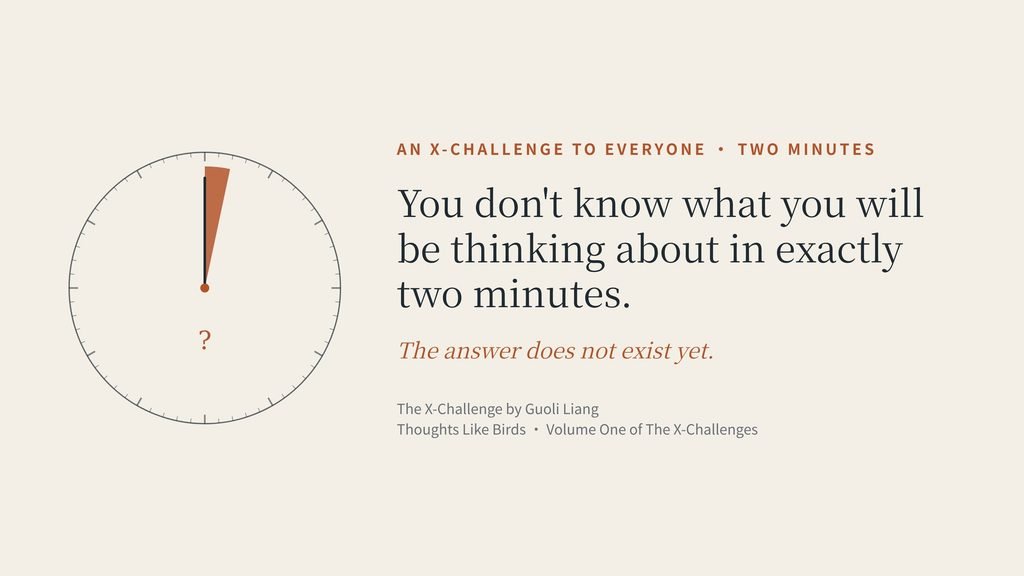
You don’t know what you will be thinking about in exactly two minutes.
Test it any way you like. Pick a word or a scene now and keep repeating it to yourself, or try to think of nothing at all. Whatever you do, you will not know what is in your mind at that moment two minutes from now.
This is not because you haven’t thought about it hard enough, or because you lack information or your surroundings are too rich. It is not because your brain is too powerful or not powerful enough, because you have read too much or too little, because your education is high or low, because your experience is long or short, and still less because you are rich or poor, noble or common. This holds for every living person.
It is because the answer two minutes from now does not exist yet. Your next thought is not a preloaded result waiting to be displayed. It is an event that has not yet occurred—and that no one, including you, can compute in advance. You have to live it into being.
We all share this not knowing. What each of us is thinking at that moment, we do not share. People in the same room, reading the same sentence, will not be thinking the same thing two minutes from now. An AI model, its parameters and its state can in principle be copied. A human life history cannot. Each person is shaped by every experience, every relationship and every choice, through an irreversible sequence in time. That sequence cannot be copied or replayed. “Each human brain is not just different. It is unreproducible.”
Over many years, many people in many countries have taken this challenge face to face. No one has succeeded. Now it is open to every living person. If you can know, before it arrives, what you will be thinking at that moment two minutes from now, post your proof in the replies.
II. What It Means
More than a thousand years ago, the Diamond Sutra said that all conditioned things are like a dream, an illusion, a bubble, a shadow, like dew, like a flash of lightning. Human cognition is exactly like that.
Facing this unpredictability of cognition, every civilization and culture built writing, language and architecture: a physical world that could last. But once a living thought becomes language, it dies once. It can then be carried anywhere, but it lives again only in a living person. Civilization learned to carry the frozen form, and people had no choice: they “lived entirely inside the frozen layer, having forgotten there was ever a source.”
It is the old Chinese fable of the man who marked his boat to find the sword he had dropped in the river: we have kept steering the present, and predicting the future, by the past.
Today’s leading AI systems, built around language models and world models, are the most powerful machinery we have ever built for steering the present by what has already been said, written, recorded and observed. Fear of AI is spreading. On October 4, Elon Musk posted on X: “No more AI. SI. It’s better.” Then, with the cover of Nick Bostrom’s Superintelligence: Paths, Dangers, Strategies: “It always was.”
When machines are being renamed “superintelligence,” the two-minute challenge points to what is most fundamental about being human.
When education tells a child what to think before the child has formed the question, and when an algorithm decides what you want to see before you want it, the right to not-yet-knowing is quietly handed over. For thousands of years, humanity has lived the lives, and built the civilizations, that follow.
In the age of AI, the clumsy work of marking the boat can be left to AI, and people can do what is truly alive. If we do not return to living value and meaning, every generation of children will only relive what the last one wrote down. That is not a future. It is a cycle.
NVIDIA’s Jensen Huang describes AI as a five-layer cake: energy, chips, infrastructure, models, applications, with energy at the base. But the cake is made by people. The cognition of every living person is not a sixth layer beneath the other five. The whole cake is wrapped in it and steeped in it. Cut off from it, the cake goes stale, and then it rots.
Not-yet-knowing is not the absence of knowledge. It is the presence of possibility.
The X-Challenges are a series of challenges to the current world, for the next civilization that future children deserve. The X-Challenge to AI was the first to be made public, The X-Challenge to Elon Musk the second. This is the next.
From The X-Challenges: Thoughts Like Birds (Volume One), the Series Preface, and “What Is AGI?” Please credit The X-Challenges when reposting.
Cases, comments and nominations: research@xchallenges.com
All public challenges: Public Challenges