
THE FIFTH X-CHALLENGE
Authentic Learning: Starting with Mathematics
First published on xchallenges.com, November 5, 2026. This is the canonical text.
In the age of AI, anyone can do what mathematicians do: ask a question of their own and follow it into mathematics. Children most of all.
Mathematics is neither where human understanding of the world begins nor where it ends. It is a distinctive language through which people understand and interpret the world, and everyone, children above all, can learn it, use it and develop it.
AI opens more doors into the language of mathematics. But the mountain behind each door is still yours to climb. As with a life, no one can live it for you.
The fifth public challenge in The X-Challenges series. November 2026.
About forty minutes. Short on time? Read Before You Begin and Section 18.
Before You Begin
On October 26, 2026, OpenAI released a paper with a one-line title: The Exponential Time Hypothesis Is False.
Russell Impagliazzo and Ramamohan Paturi formulated that hypothesis in 1999. For twenty-seven years, a great many results about how fast hard problems can be solved have rested on it.
Now Impagliazzo and Paturi, with Ryan Williams, are helping organize an open, independent examination of OpenAI’s claim that their hypothesis is false. Their involvement, they wrote, “should not be taken as certification of the claim.”
The same day, the podcaster Lex Fridman released “AI Crisis in Math,” nearly four hours of conversation with three mathematicians: Ankur Moitra of MIT, Steven Brunton of the University of Washington and Alex Kontorovich of Rutgers. On X he called the moment “either a crisis, a triumph, or both.”
It had been that kind of year. AI systems produced proofs and constructions no one had seen before. In early October, OpenAI released more than seven hundred mathematical manuscripts at once. Answers were getting cheap.
So the argument began: what is left of mathematics?
The pure mathematician who lives by solving problems is a figure only about two hundred years old. Before that, Newton, Gauss and Fourier pulled their problems out of the world. AI takes over the solving first; it cannot take over people like them.
That argument is full of forecasts about AI and pays little attention to how mathematics comes into being. Where does it come from? Where do mathematicians come from? Why is AI so good at it? Where does it go next?
Follow those questions far enough and they meet. Every problem that shaped mathematics first had to become a problem worth pursuing. How does that happen?
This is the Fifth X-Challenge. It makes two claims and stakes a public bet on each; either bet can be lost.
The first points down: however advanced the mathematics, its cognitive starting point can always be found in a child.
The second points up: where mathematics digs next, which questions get pursued, is still decided by people.
If the Fifth X-Challenge loses a single case under either claim, it concedes.
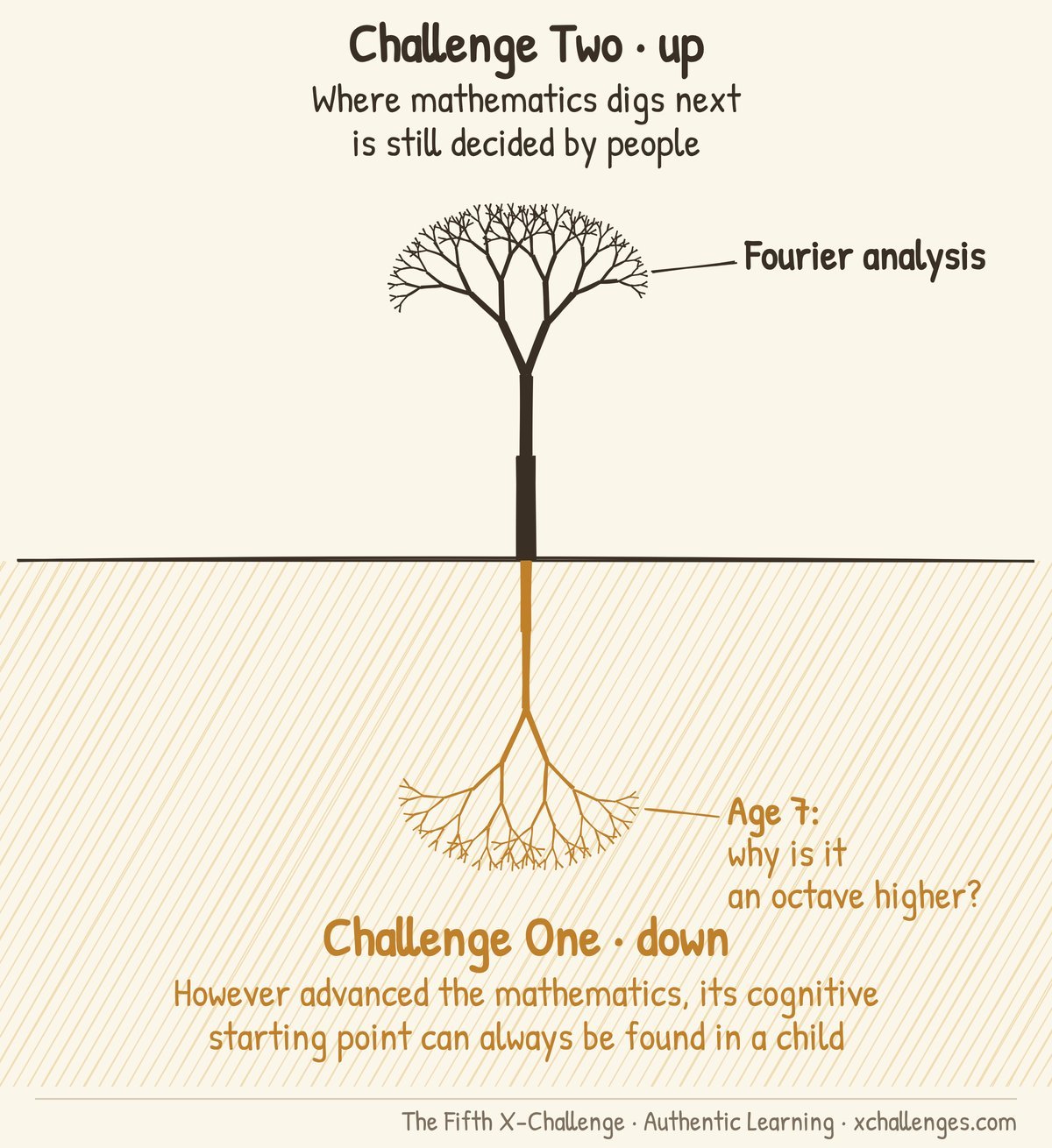
Figure: A tree of cognition. Challenge One points down: can the cognitive starting point of any mathematics, however advanced, be found in a child? Challenge Two points up: who decides where mathematics digs next?
In this essay, authentic learning does not mean handing children the questions and conclusions we adults have already arranged, which to a child are knots someone else has tied. It means learning the way we ourselves learn when we truly learn something: the question is our own, not assigned, and it comes out of the life we are living. Children should be allowed to raise their own questions in the course of real life, so that a real question becomes the child’s own, and the child does the knotting.
Knotting means taking people and things in the world that had nothing to do with you, connecting them to yourself, getting the connection right, so that they become your own cognition and experience: your own property.
Authentic mathematical learning lets a person walk the whole path of mathematics itself: pose a question, turn it into mathematics, conjecture and solve, see why it must hold, make it simpler and more general, then take it back to the world to test and use, and find the next question there.
Authentic learning was first put into practice in 2014 at the first 3.0 Future School, Zhongguancun No. 3 Primary School, a public school whose whole-school innovation was approved as a project by the Beijing municipal and Haidian district governments. That spring, more than a hundred innovative schools, among them schools from Finland and the United States, practiced it together; in July they gathered in Chongqing, China’s city of bridges, to share their work at Bridge: Global Educational Community and the Second International Conference on Primary Education. The conference logo was designed by students of Nanyou Primary School in Shenzhen.
Part One: Where Mathematics Comes From
1. It begins in people and their lives
The roots of mathematics are older than writing.
Before they can talk, infants register some differences in quantity, and stare longer when an object that should still be there vanishes. Elizabeth Spelke calls this core knowledge. Stanislas Dehaene calls it the number sense.
People put those intuitions to work: measuring fields, counting harvests, keeping calendars, watching stars, tuning strings. In many places, they did so independently. Four lines run through what follows: number, shape, uncertainty and change, each fed by several streams.
Number came first. In Mesopotamia, accountants kept count with small clay tokens, different shapes for different goods, and later pressed the tokens’ shapes into wet tablets; the recording of number and the beginnings of writing became entangled. In China, counting rods were laid out in a base-ten place system, with a blank space marking an empty place. The Nine Chapters on the Mathematical Art worked from problems to methods. Its two hundred and forty-six problems deal with fields, granaries and taxes: how large a field is, how much a granary holds, how a tax should be shared among households. From them it drew a general method for each kind.
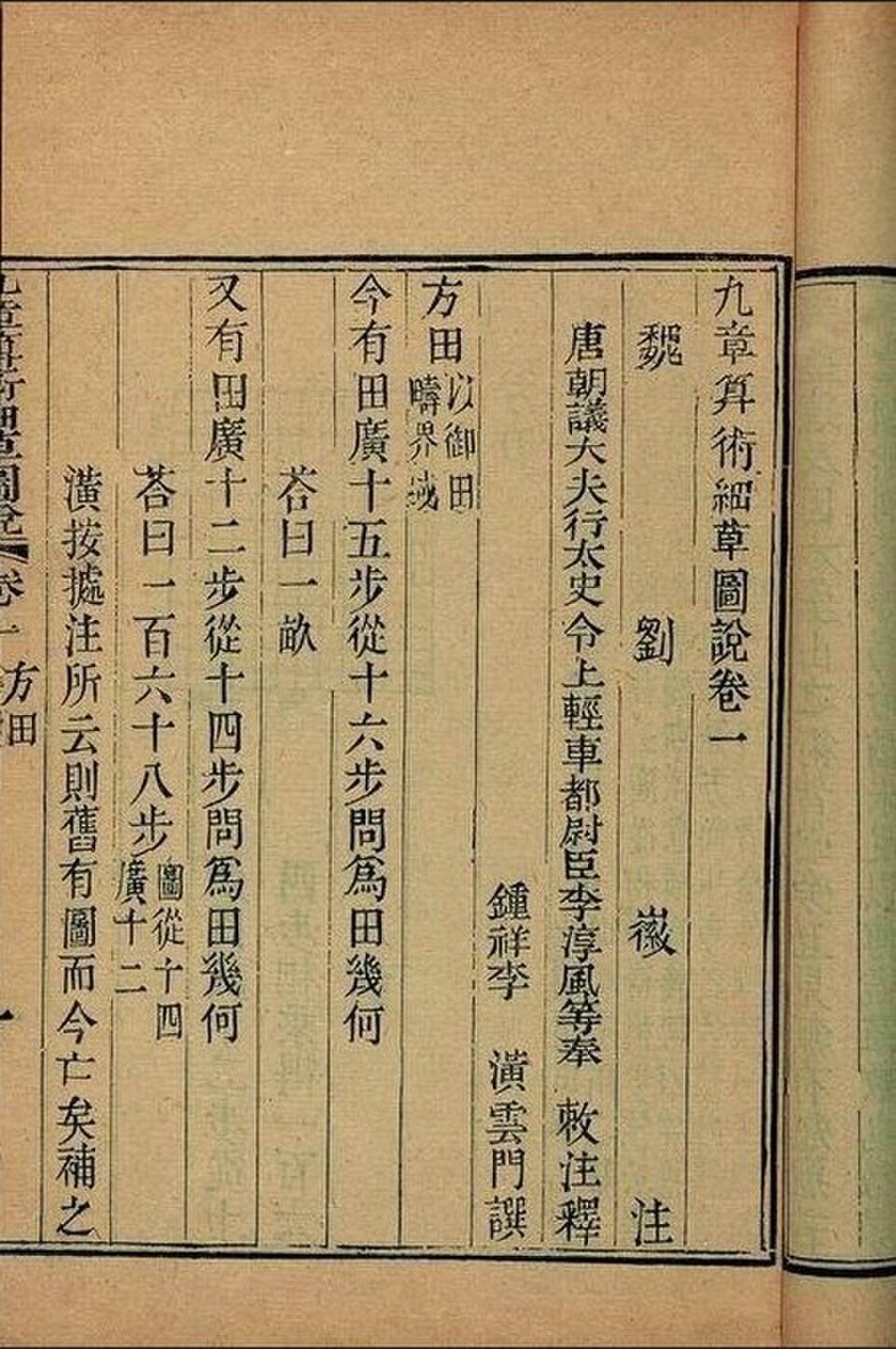
Figure: The opening of chapter one, “Field Measurement,” in Li Huang’s Qing-dynasty Detailed Solutions and Diagrams for the Nine Chapters, which preserves the commentaries of Liu Hui and Li Chunfeng. Its first problem asks how large a field is.
Indian mathematicians gave the empty place a sign of its own: zero. In the seventh century Brahmagupta wrote down rules for calculating with it. In the ninth century, in Baghdad, al-Khwarizmi described the Indian place-value system in Arabic, and another of his books gave us the word “algebra.” The numerals reached Europe in Latin translation, and Fibonacci of Pisa’s Liber Abaci of 1202 did more than any other book to spread them there. The digits from 0 to 9 that every child now learns are where Indian, Arabic and European streams flowed together.
Then shape. Several ancient civilizations met the relation among the sides of a right triangle, each for reasons of its own.
A Babylonian tablet the size of a palm, made around 1800 BCE and now called Plimpton 322, sits at Columbia University in New York. Its fifteen rows of numbers each correspond to a right triangle. Some scholars argue that it was a teacher’s aid for setting problems; its purpose is still debated.
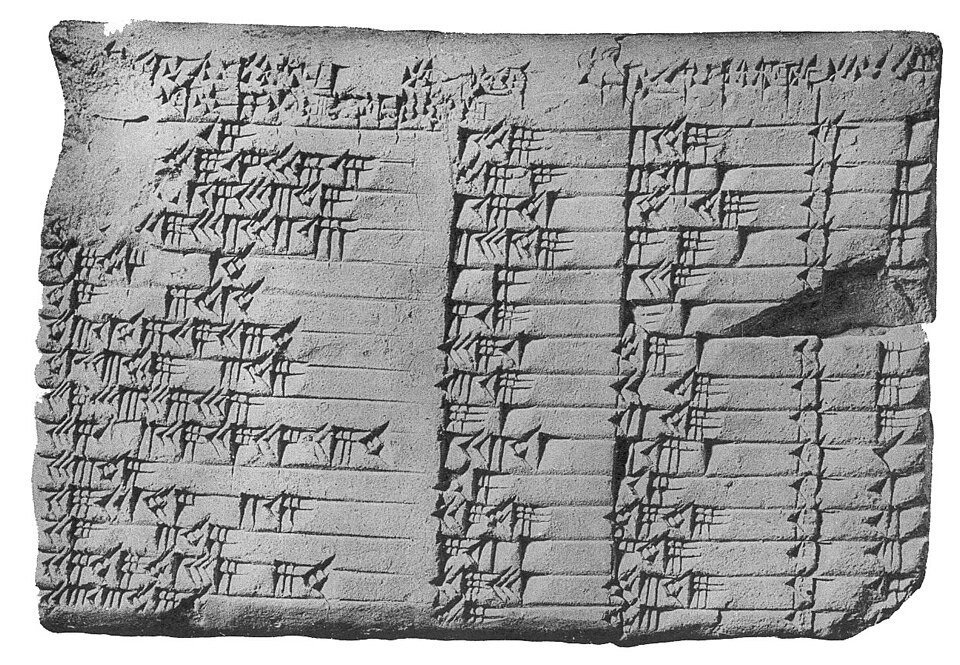
Figure: Plimpton 322. Old Babylonian, about 1800 BCE, roughly 13 cm wide, broken on the left. Bought by the collector George Plimpton around 1922 and later bequeathed to Columbia University.
In India, the Śulba-sūtras gave priests the rule for the diagonal of a rectangle, which they needed to lay out fire altars with cords. In China, the Zhoubi Suanjing records Shang Gao’s “three for the base, four for the height, five for the slant,” set down for measuring the sun’s shadow and the height of the sky and the breadth of the earth. In the third century Zhao Shuang drew a figure for it: four identical right triangles arranged inside a large square, leaving a small square in the middle. Rearrange and count, and the relation is proved. Some seventeen centuries later, that figure became the emblem of the 2002 International Congress of Mathematicians in Beijing.
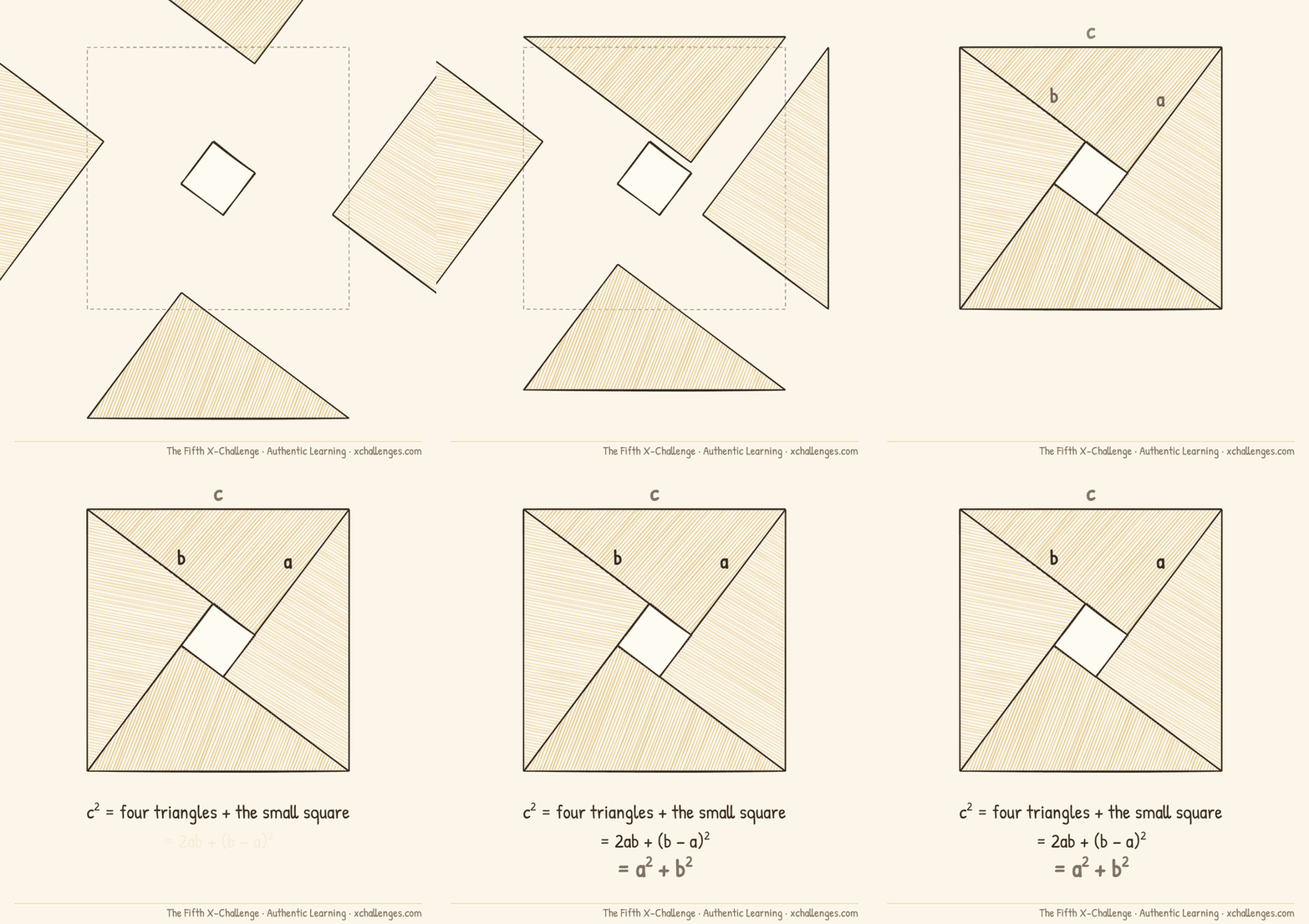
Figure: Zhao Shuang’s figure, redrawn from its structure. The area of the large square equals that of the four triangles plus the small square, which gives a² + b² = c².
The Greeks took another road. Around 300 BCE, Euclid’s Elements derived the relation step by step from a few axioms. From then on, deductive proof became the standard of mathematics in the Greek tradition, and much later far beyond it.
Who learned it from whom is often impossible to say; perhaps no one had to. People in different places, in their own lives, ran into it. This part of mathematics grew out of everyday life. But whoever wrote it down first, the relation among the three sides could not have come out any other way.
Mathematics did not stop at measuring and keeping accounts, though. It grew into a language.
2. A human language that grew with everything else
Mathematics is a distinctive human language. It belongs to no single people; many streams flowed into it. It turns quantity, structure, change, uncertainty and relation into objects that can be reasoned about, tested and carried from one field to another, which is why it moves so freely among science, technology and engineering.
Much of it was not built first and applied later.
A river ran through the city of Königsberg, crossed by seven bridges. The townspeople had a puzzle: could you take a walk that crossed each bridge exactly once? No one managed it, and no one could say why.
In 1735 Leonhard Euler took up the question. He threw away the shape of the riverbanks, the length of the bridges and the distances between streets, and kept only the pieces of land and the bridges joining them. In modern terms, land became points and bridges became lines.
The problem suddenly became simple. A piece of land touched by an odd number of bridges can only be where the walk begins or ends. All four pieces of land in Königsberg touch an odd number of bridges, and a walk has only one beginning and one end. So no such walk exists.
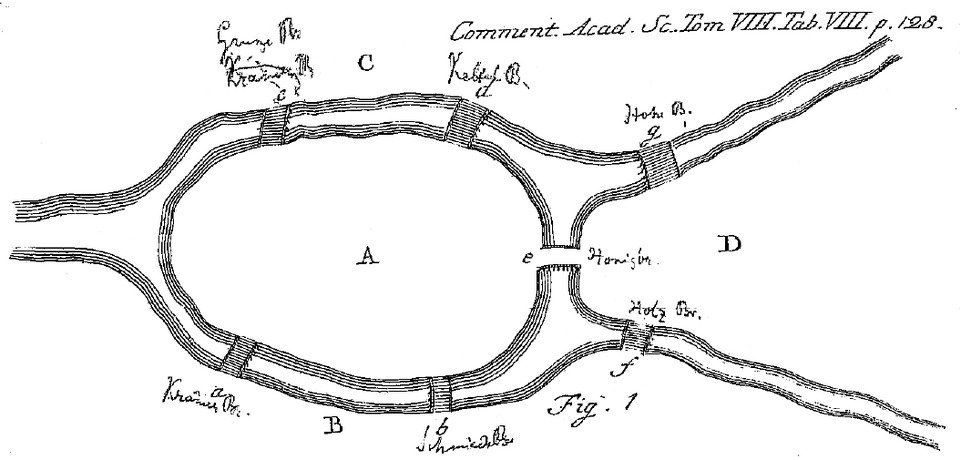
Figure: Euler’s figure of the Königsberg bridges. He presented the paper to the St. Petersburg Academy in 1735; it appeared in the Academy’s Commentarii, volume 8, in 1741.
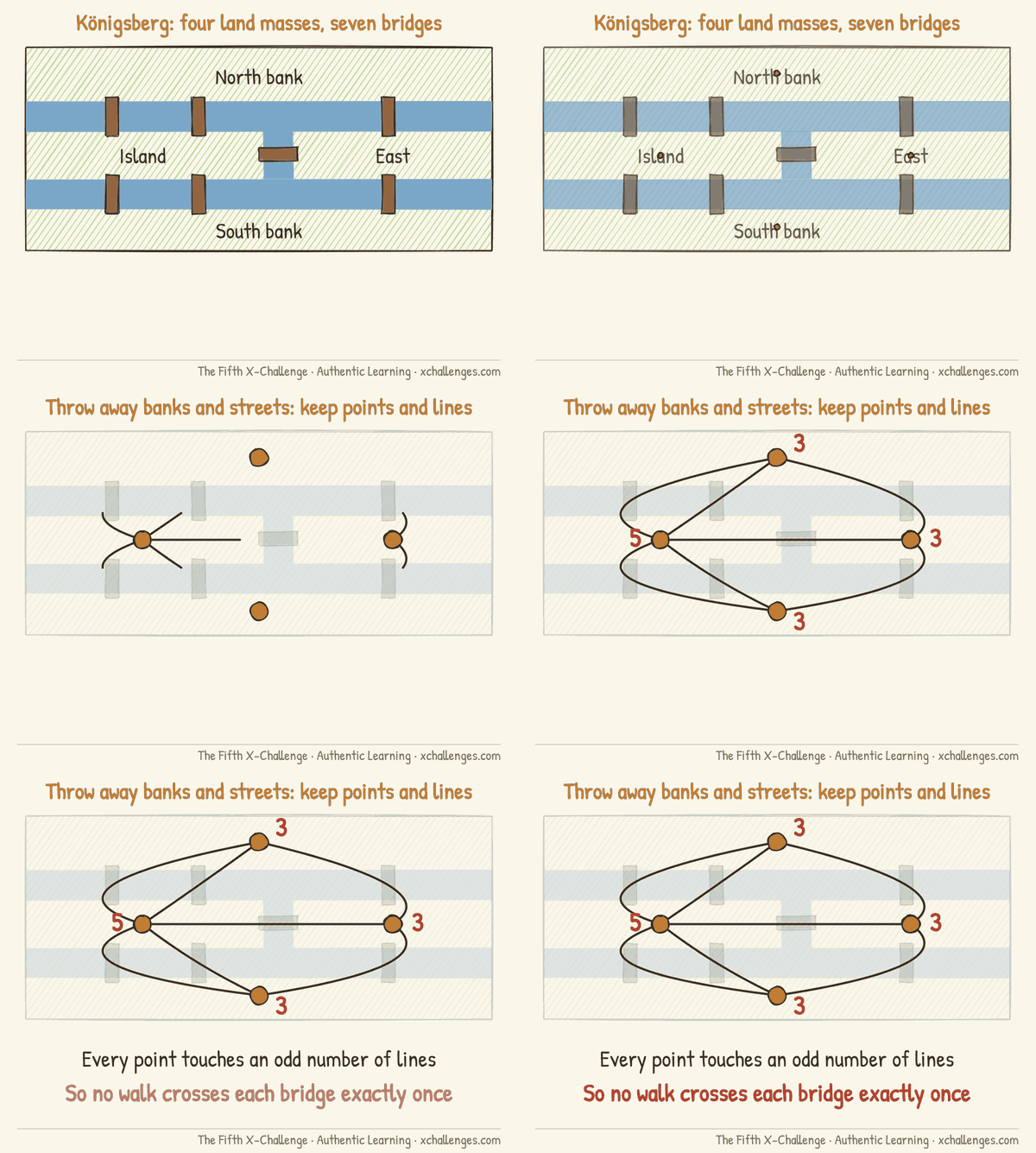
Figure: From a map to points and lines, in a modern rendering. Four pieces of land become four points and seven bridges become seven lines. The points touch 5, 3, 3 and 3 lines: all odd.
Graph theory grew out of that walking puzzle. Calculus and Fourier series arose the same way, out of motion and heat.
Uncertainty entered mathematics out of a game. In 1494 the Italian friar Luca Pacioli set a problem in an arithmetic book. Two teams play ball for a stake; whoever first scores six goals takes it all. The game is interrupted at five goals to two. How should the money be divided? Pacioli said: five to two.
He was wrong. Gerolamo Cardano and Niccolò Tartaglia objected, but for a century and a half no one found the right division. In 1654 a French gentleman with a taste for gambling, Antoine Gombaud, the Chevalier de Méré, brought problems of this kind to Blaise Pascal, who wrote to Pierre de Fermat in Toulouse. In a handful of letters the two worked it out. The split should depend not on goals already scored but on each side’s chances if the rest of the game were played. If the teams are evenly matched, the trailing team must score four in a row to come back, a chance of one in sixteen. The stake should be divided fifteen to one.
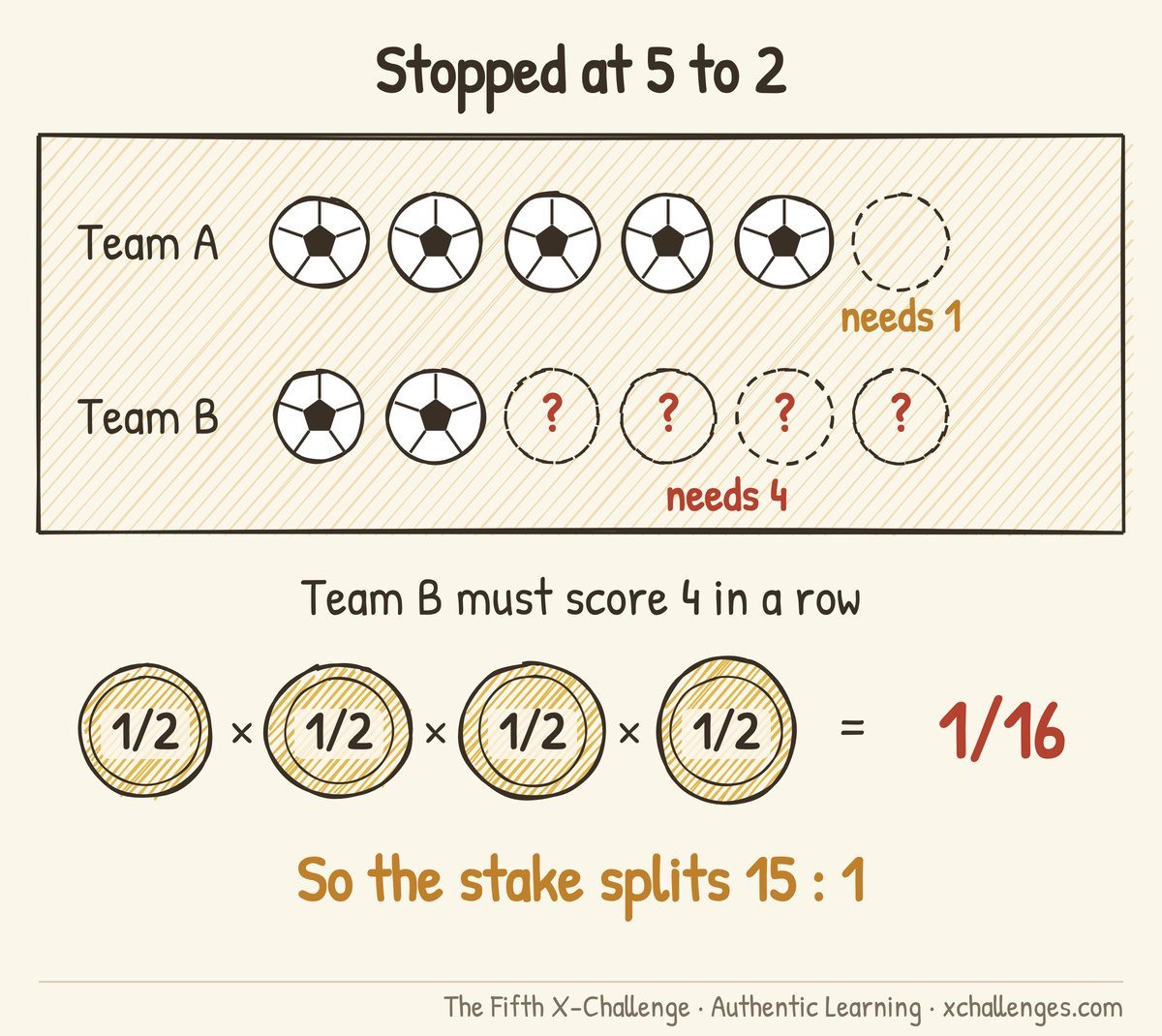
Figure: The unfinished game. The leading team needs one more goal; the trailing team needs four in a row. The chance of that is four halves multiplied together: one in sixteen.
Probability theory was born in those letters.
The traffic also runs the other way. Riemannian geometry, which grew from Carl Friedrich Gauss’s study of curved surfaces, developed for more than half a century as pure mathematics before it became the language of general relativity. Number theory, long the proudest example of useless mathematics, now underpins the public-key cryptography that secures much of online communication.
The world gives rise to mathematics, which then grows on its own terms until some of it finds its way back.
Across these histories, one move keeps recurring: a smaller structure captures more of the world. When Euler threw away the riverbanks and the streets, he made that move.
Some seventeen hundred years ago, the Chinese mathematician Liu Hui, commenting on the Nine Chapters, said he hoped his explanations would be concise yet complete, connected yet never cluttered.
The X-Challenges understands mathematics in that spirit: mathematics is about how simple and how general an act of cognition can be. Beauty is what we feel when we recognize that simplicity; the “why” is what makes it hold.
But to the person learning it, even the simplest formula is a knot someone else has tied. To make it your own, you have to tie it again yourself.
Simplicity did not arrive smoothly. Sometimes it was forced out by a crisis.
3. Crisis forces invention
Change, too, had more than one source. Archimedes in ancient Greece and Liu Hui in third-century China both closed in on the circle with polygons of more and more sides: the more sides, the closer, yet never quite there. In the seventeenth century Isaac Newton and Gottfried Leibniz each invented calculus, turning “closer and closer” into something that could be calculated. With Fourier, the language of calculus ran into a crisis.
In 1801 Joseph Fourier came home from Napoleon’s expedition to Egypt, and soon afterward Napoleon made him prefect of the Isère department, based in Grenoble. Draining marshes and building roads were his job. Heat was not; no one had given it to him. From around 1804, in the time his office left him, he worked out how heat spreads through a solid body and wrote down the equation that governs it.
To solve that equation, he had to write an arbitrary distribution of temperature along an iron bar as a sum of sine waves. Daniel Bernoulli had proposed the same idea more than fifty years earlier for a vibrating string, and Euler and others had rejected it. Fourier carried it from the string to heat and pushed it further: however strangely the temperature is distributed, it can be written that way.
A sine wave is a smooth, rolling curve that never breaks. Yet Fourier claimed that enough of them, added together, could produce even a sudden jump: one stretch of the bar at one temperature, the next stretch abruptly lower.
In 1807 he read the paper to the Paris Institute. Two of its referees, Joseph-Louis Lagrange and Pierre-Simon Laplace, objected. How could smooth things add up to something that is not smooth?
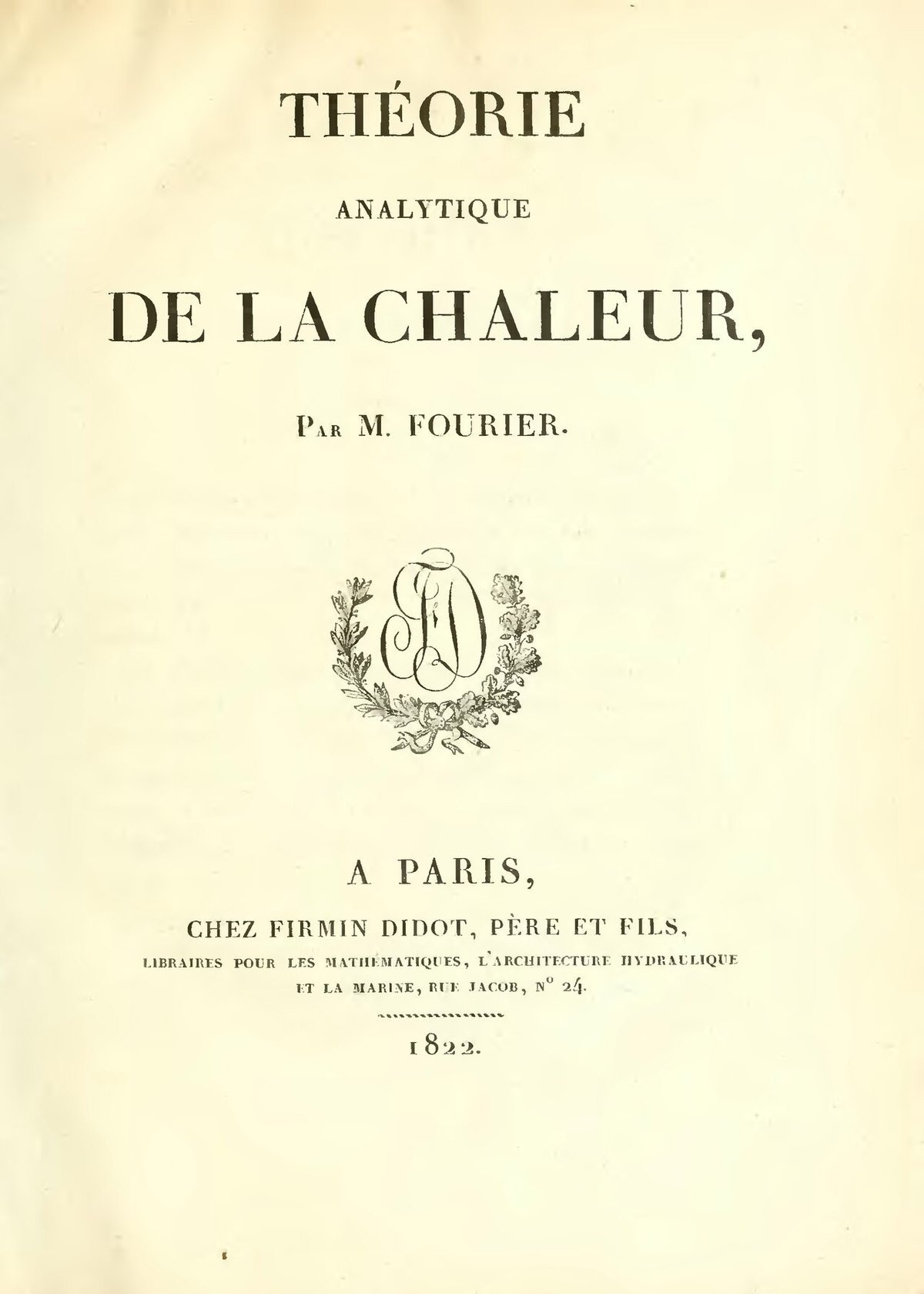
Figure: Title page of Fourier’s Théorie analytique de la chaleur, Paris, 1822, fifteen years after he first read his paper.
In 1821 Augustin-Louis Cauchy asserted, in his Cours d’analyse, that the sum of a convergent series of continuous functions must itself be continuous. In plain words: add up infinitely many curves, each drawn without lifting the pen, and as long as the total settles toward a definite result, that result can be drawn without lifting the pen too.
Five years later a young Norwegian without a post, Niels Henrik Abel, published a paper in the first volume of a new Berlin journal showing that the claim had exceptions. He used sine waves: curves that never break, added up until the sum breaks.
On one side stood one of the most authoritative analysts in Europe, on the other a young man nobody had hired, and the mathematics sided with the young man.
Some twenty years later, George Stokes and Philipp Seidel found the unstated condition hiding in Cauchy’s proof: every point has to settle toward the result in step with every other, not each at its own pace. Karl Weierstrass made that condition, uniform convergence, a standard of analysis.
Fourier’s own series held a surprise as well. Build a square wave, a signal that jumps back and forth between high and low, out of sine waves, and the more terms you add, the more it looks like a square wave. But at every jump the curve overshoots and leaves a bump. With more terms the bump grows narrower, yet its height stays at about nine percent of the jump and never goes away. It came to be called the Gibbs phenomenon.
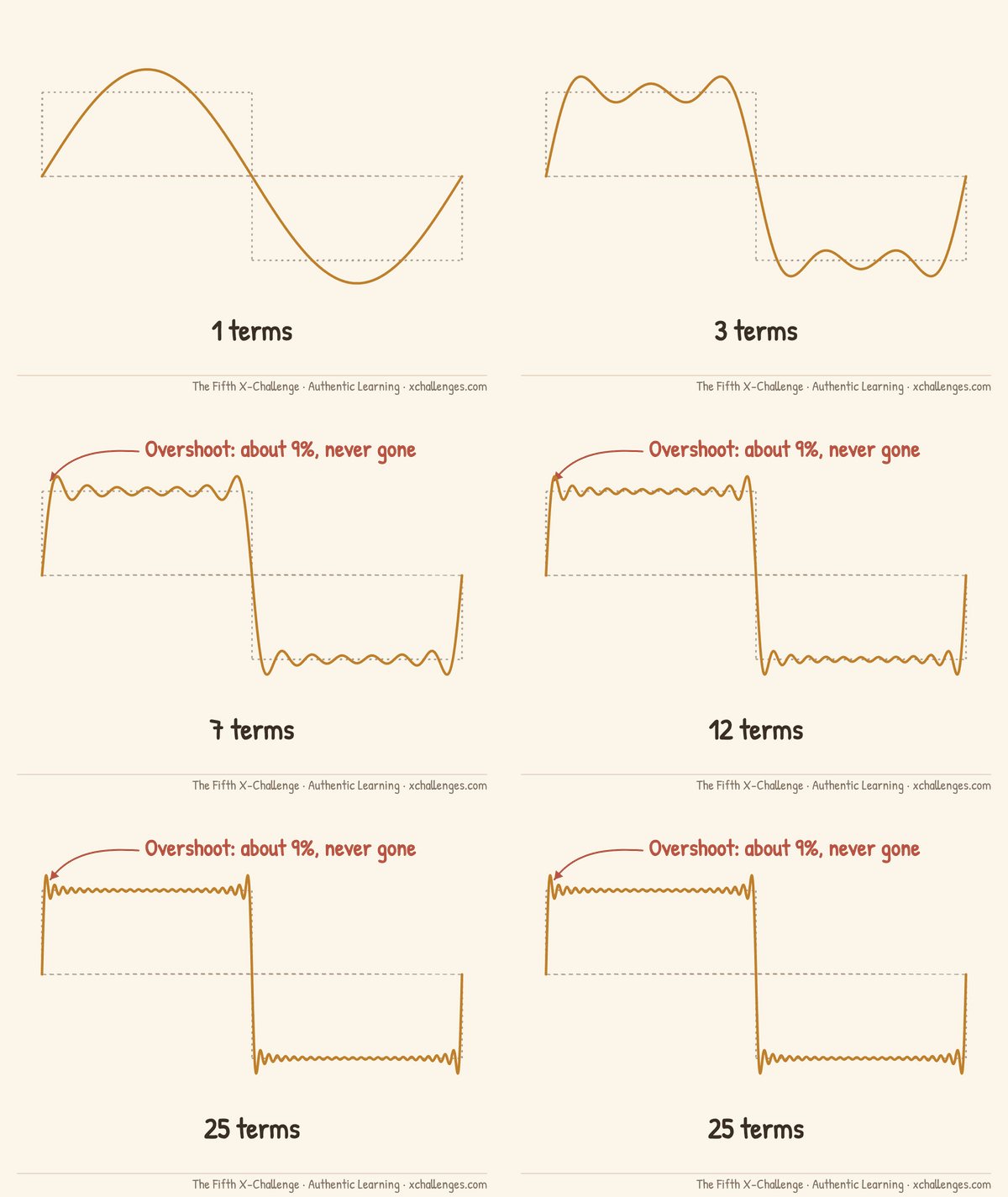
Figure: Building a square wave from sine waves with 1, 5 and 25 terms. The fit improves, but at each jump an overshoot remains.
More is not the same as perfect.
Fourier’s daring, Cauchy’s assertion, Abel’s counterexample: each began with a question of its own. Where do questions come from, and who decides which ones matter?
4. Questions can be invented; their answers are not up to whoever asks
In 1867, twenty-two-year-old Georg Cantor attached a proposition to his doctoral dissertation in Berlin: “In mathematics the art of proposing a question must be held of higher value than solving it.”
On August 8, 1900, David Hilbert stood before the International Congress of Mathematicians in Paris with a list of problems. The published list has twenty-three. On stage, he presented ten. For more than a century, the list steered much of mathematics.
On May 24, 2000, the Clay Mathematics Institute issued another list in Paris: seven Millennium Prize Problems, a million dollars each. So far Clay has awarded only one, for the Poincaré conjecture, and Grigori Perelman declined it. In both cases, people decided which questions would mark the frontier.
Kontorovich put it this way: “we’re discovering answers to questions that we’ve invented.”
The answers are not up to whoever asks. Arrange nineteen blocks any way you like; they will never make any rectangle except a single line. That is true for every child and every mathematician. Nineteen is prime.
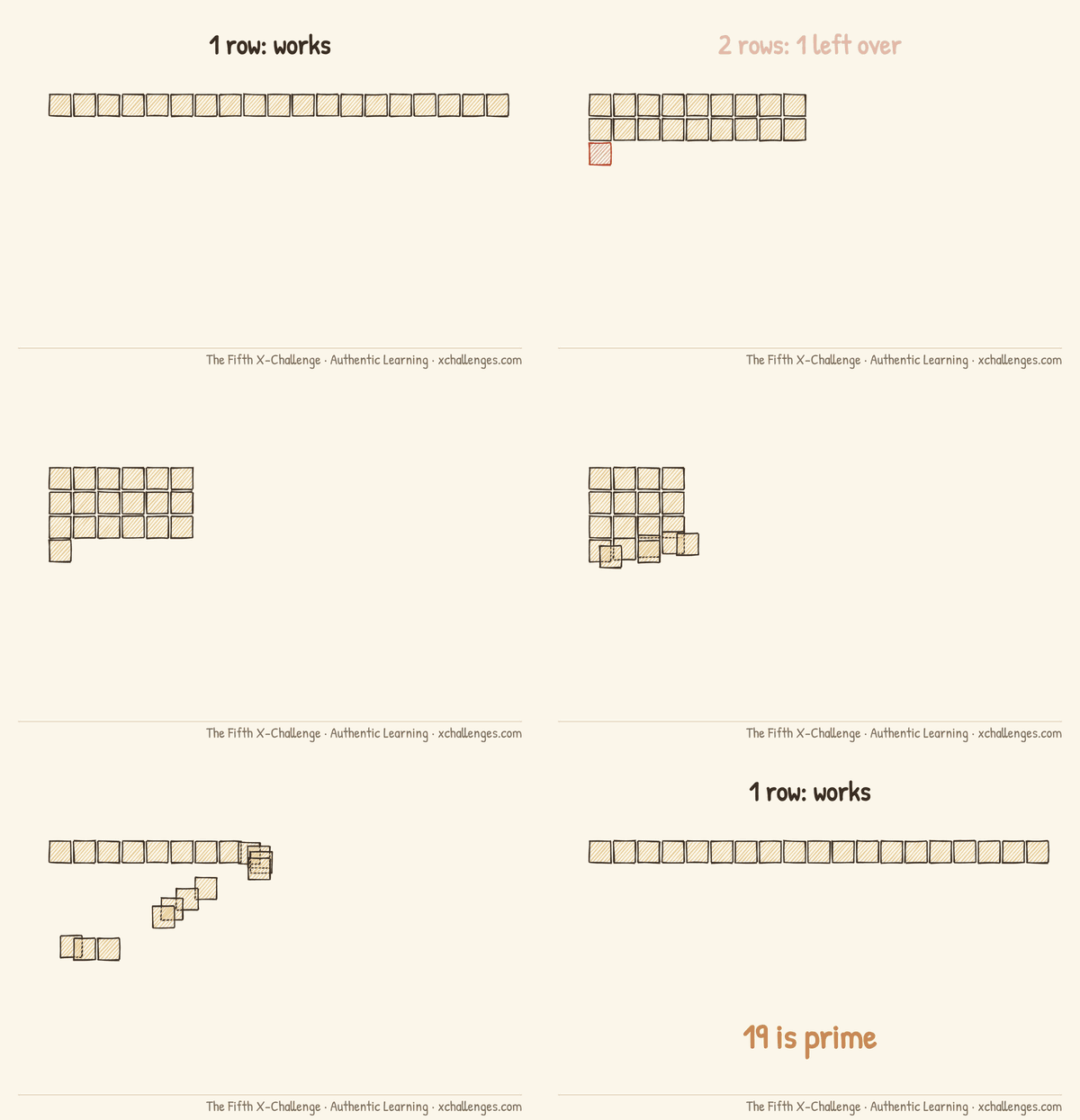
Figure: Nineteen blocks. A single line works; try two, three or four rows and there are always blocks left over. Nineteen is prime.
Solving, meanwhile, has been handed to tools again and again, from counting rods to logarithms, from computers to proof assistants. In 1614 John Napier published his logarithms, which turn multiplication into addition. In 1976 the four-color theorem was proved only after a computer checked more than a thousand cases, and mathematicians argued for years over whether that counted as a proof. In 2014 a machine-checked proof of the Kepler conjecture was completed. Proof assistants like Lean now check a proof line by line. And in 2026, on problems whose answers can be checked, AI produced solutions and constructions no one had seen before.
Each time tools took over more of the solving, mathematics went further.
Seen from here, mathematics is a great river. Its water comes from many streams, which rise with Mesopotamian accountants, Chinese reckoners measuring fields, Indian priests laying out altars with cords, Pascal writing letters about an unfinished game, and Fourier studying heat between the duties of a prefect. At the source of every stream is a person who, in the course of their own life, ran into a question that mattered to them.
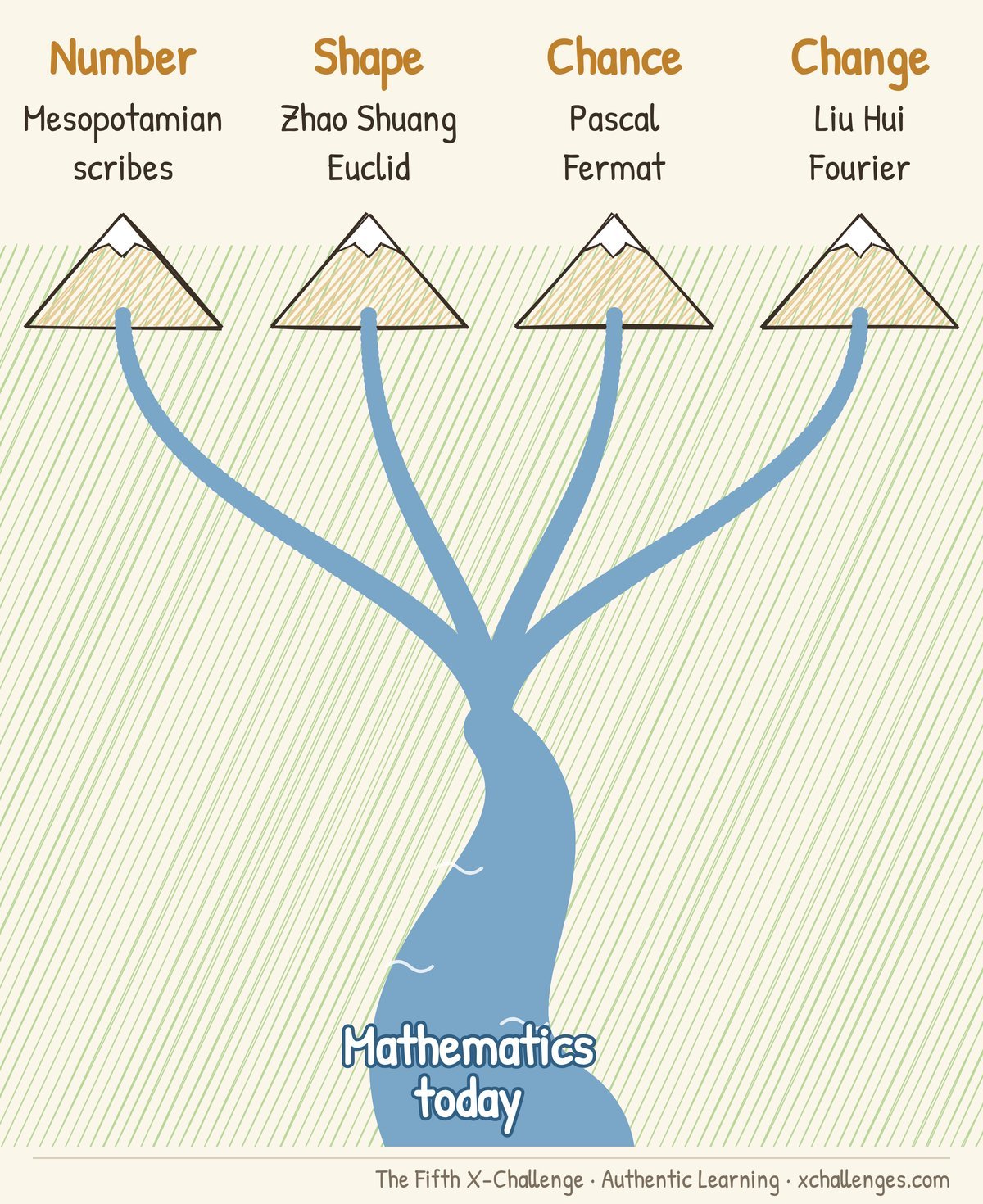
Figure: Streams into a river. Number, shape, uncertainty and change each flow from different civilizations, people and questions, and join in the mathematics of today.
Today AI has drunk thousands of years of that river in one draught, more and faster than anyone. Two questions remain. Can a child reach the source of a stream? And where will the next stream come from, and who will open it?
Part Two: Where Mathematicians Come From
5. Children are already asking
On Lex Fridman’s show, Brunton described the primes as a distillation of a three-year-old’s sense of mystery. Kontorovich talked about those nineteen blocks. Kids love primes, he said; kids can discover them.
For children, questions often come before solutions.
Why can’t you divide by zero? Why does the moon follow me? After five heads in a row, isn’t tails due? Why do a flute and a violin playing the same note sound different?
These questions follow the four lines of Part One: number, shape, uncertainty and change.
Questions like these are almost always new only to the child. Yet every one is real: nobody assigned it, nobody will grade it, and the child asks only to know.
6. One string
A seven-year-old boy lays a guitar flat across his knees. He rests one finger on the string at the twelfth fret, not pressing, just touching, and plucks.
A note floats up, a full octave higher, thin and clear.
Why does a light touch lift the note an octave? Why does the same note sound different on a guitar and a flute?
No one assigned these questions. He has tied that note to himself. That is knotting.
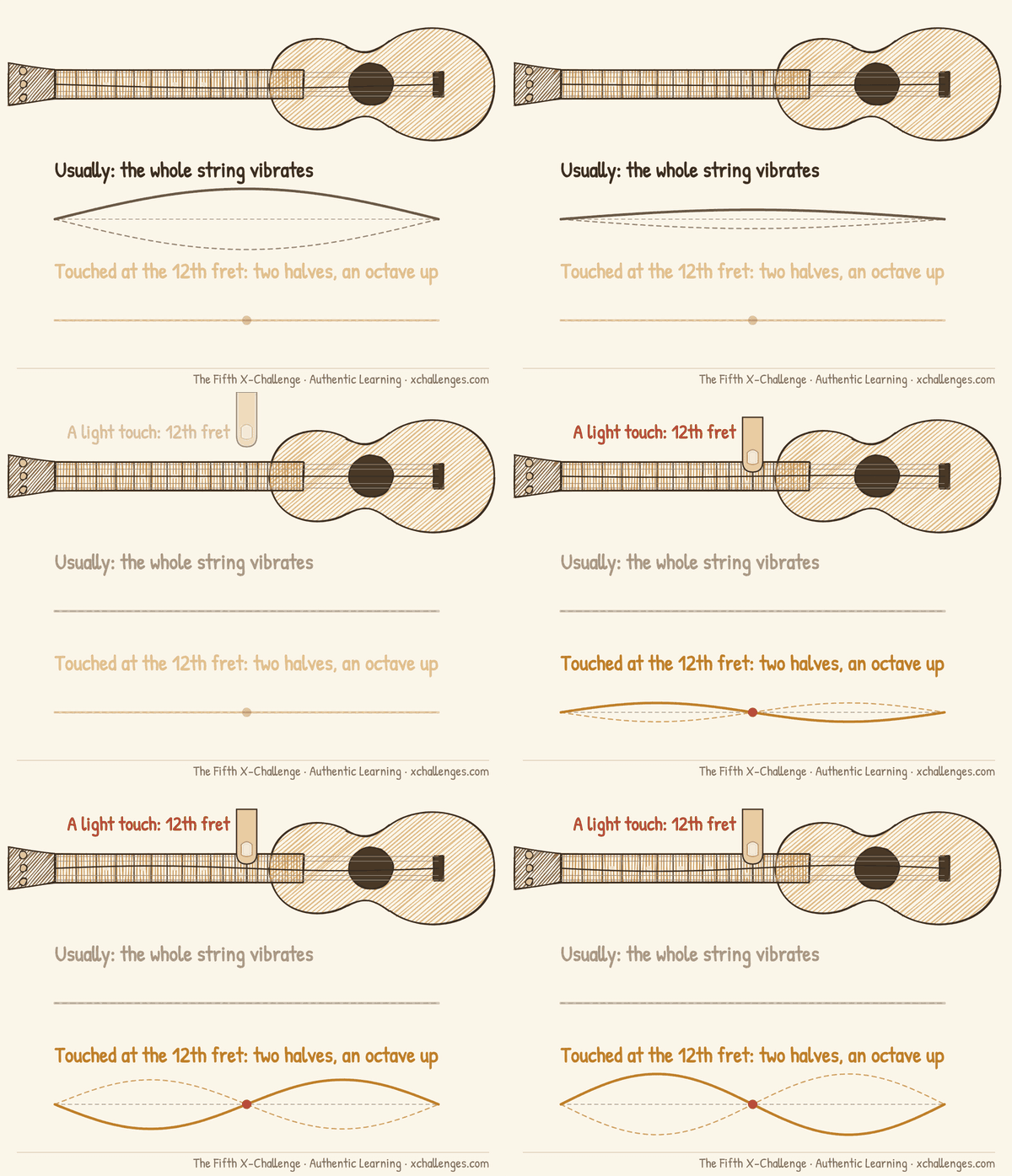
Figure: Usually the whole string vibrates and sounds its fundamental. Touched lightly at the twelfth fret and plucked, it vibrates in two halves, at twice the frequency, an octave higher.
Without knowing it, he has touched the string Bernoulli and Euler argued over, and the edge of the field that bears Fourier’s name.
Followed far enough, his question leads to orthogonality, a genuine threshold in Fourier analysis.
Start with an ideal periodic signal, built from a few whole-number harmonics, none of them too fast to be told apart by the samples you are about to take. Take eight equally spaced samples in one cycle. Multiply the samples, point by point, by a sine wave of one candidate frequency, add, and divide by eight. Then do the same with the cosine. If the candidate harmonic is not in the signal, both sums come out to zero. If it is, at least one of the two sums is not zero.
The computation is a finite inner product, the discrete counterpart of the integral that defines orthogonality in the full theory.
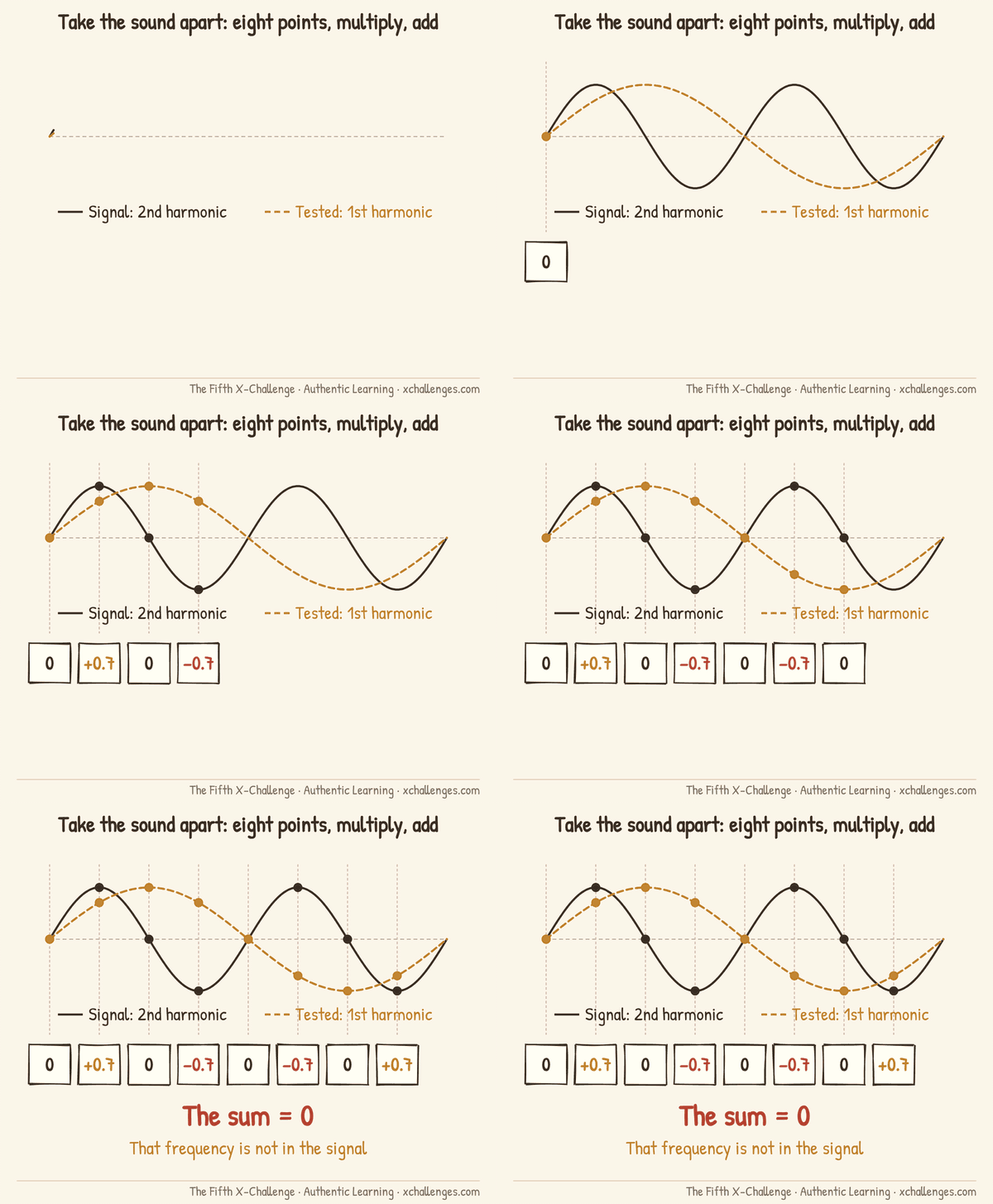
Figure: Take eight points in one cycle. Multiply the signal (solid, the second harmonic) by the sine wave being tested (dashed, the first harmonic) point by point, then add. That frequency is absent from the signal, so the sum is zero.
Back on a real guitar, the numbers are no longer clean zeros. Strings are stiff; notes have attacks and noise. The same procedure still pulls the frequencies out.
That one string opens into physics, engineering, signal processing and history, and into language too, because the boy has to find words for what he hears. Thoughts Like Birds, the first volume of The X-Challenges, puts it this way: “The child’s neural configuration has not yet been pruned into disciplinary channels.”
In a child’s life the question comes before the subject, and it does not arrive on a timetable.
7. One ladder
Where do schools put Fourier?
For this challenge, the curriculum frameworks of eight school systems were checked: China, England, Finland, France, Japan, Singapore, South Korea and, for the United States, which has no national curriculum, the Common Core standards and the College Board’s AP Calculus course.
The frameworks share a skeleton. Trigonometric ratios arrive somewhere between the ages of eleven and sixteen. Where integration appears before university, it is generally in upper-secondary elective, specialist or college-preparatory courses. Fourier series appear in none of them. The nearest thing is a discrete Fourier transform on an optional problem list in a French upper-secondary elective. Systematic study of Fourier series usually waits for university mathematics, physics or engineering.
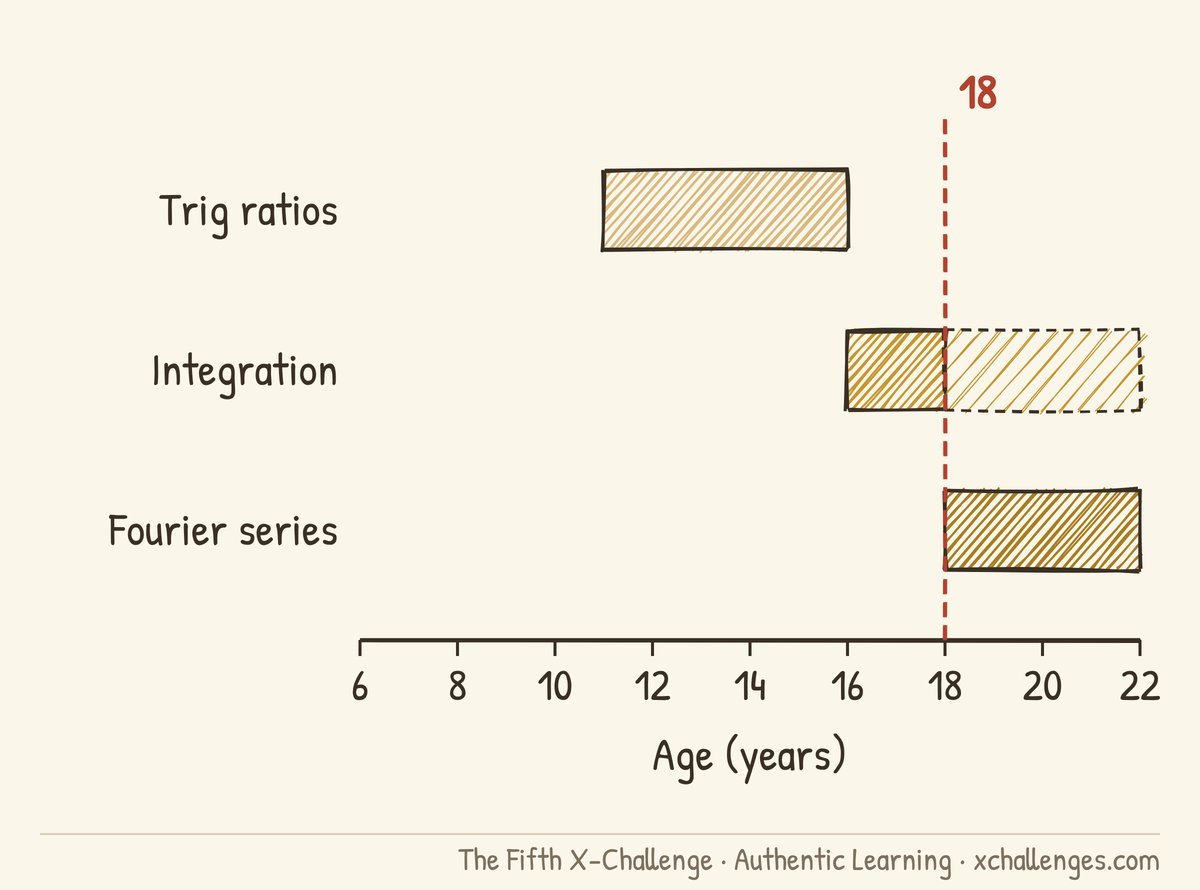
Figure: Roughly when trigonometric ratios, integration and Fourier series appear across eight school systems. Trigonometric ratios arrive between the ages of eleven and sixteen; integration mostly in late upper-secondary electives or college-preparatory courses; Fourier series only at university.
Age-graded mass schooling took shape in the nineteenth century, for organizational as well as pedagogical reasons. The grade-by-grade ladder it built tells us how institutions sequence mathematics. It does not tell us the earliest age at which a mathematical structure can be reached. Whether it can be reached before eighteen is what Challenge One (Section 18) tests.
8. The ladder and the spiral
In 1956, Benjamin Bloom and colleagues at the University of Chicago published the Taxonomy of Educational Objectives. It sorted cognitive objectives into six levels, from simple to complex: knowledge, comprehension, application, analysis, synthesis, evaluation, and assumed that mastering each lower level was a prerequisite for the next. One of its most frequent uses was to classify curricular objectives and test items, and it lent the curriculum, laid out grade by grade as a ladder, a supposedly cognitive foundation. The 2001 revision put “create” at the top and relaxed the strict hierarchy.
Four years later, in 1960, the Harvard psychologist Jerome Bruner put forward a famous hypothesis in The Process of Education: “any subject can be taught effectively in some intellectually honest form to any child at any stage of development.” He proposed a spiral curriculum, in which the same core ideas return at different ages, deeper each time. Later he distinguished three modes of representation: enactive (through action), iconic (through images) and symbolic (through language and symbols). Zhao Shuang’s figure uses all three: you assemble it by hand, see it with your eyes and then write it as an equation.
The spiral was not his idea alone. Soviet curriculum theory had long weighed linear against concentric, or spiral, arrangements of subject matter, and a Chinese commentary on the 2022 national mathematics standards for compulsory education stresses teaching that follows “the principle of spiral ascent.” From another direction, the Soviet psychologist Vasily Davydov tested something like Bruner’s hypothesis. In the early 1960s he ran school experiments in which first graders compared lengths, weights and volumes, and wrote the relations between quantities in letters, before they learned specific numbers.
In the classroom, though, the spiral has mostly straightened into a ladder. Whole-class teaching makes dozens of children walk one route at once; teaching by subject cuts mathematics off from other subjects and then into periods; the route has to be fixed by adults in advance. This is the mismatch Section 15 describes: an industrial shell around an agricultural core. In 1983 the American report A Nation at Risk set off a standards-based reform movement; in 1989 the National Council of Teachers of Mathematics published the first widely adopted national standards for school mathematics. Curriculum standards then became the bar that national education is measured against; from 1994, American federal education funding was tied to them and to the tests that went with them. Many countries took a similar road. So the curriculum theory in many countries says spiral, while curricular practice is a straight ladder with a crossbar of assessment at every grade. Personalized learning inside that frame looks for individual differences within standardization. It is a placebo.
Nor does that ladder add up to one ladder. In the Chinese and US standards, each domain is cut into pieces, rearranged from one school stage to the next and cut up again in high school; the pieces needed to reach Fourier sit on different ladders. And as children climb, many lose interest. In China’s 2018 national monitoring of compulsory education, the share of students with high interest in mathematics fell from 43.0 percent in grade 4 to 19.2 percent in grade 8; in TIMSS 2023, a quarter of American eighth graders did not value mathematics.
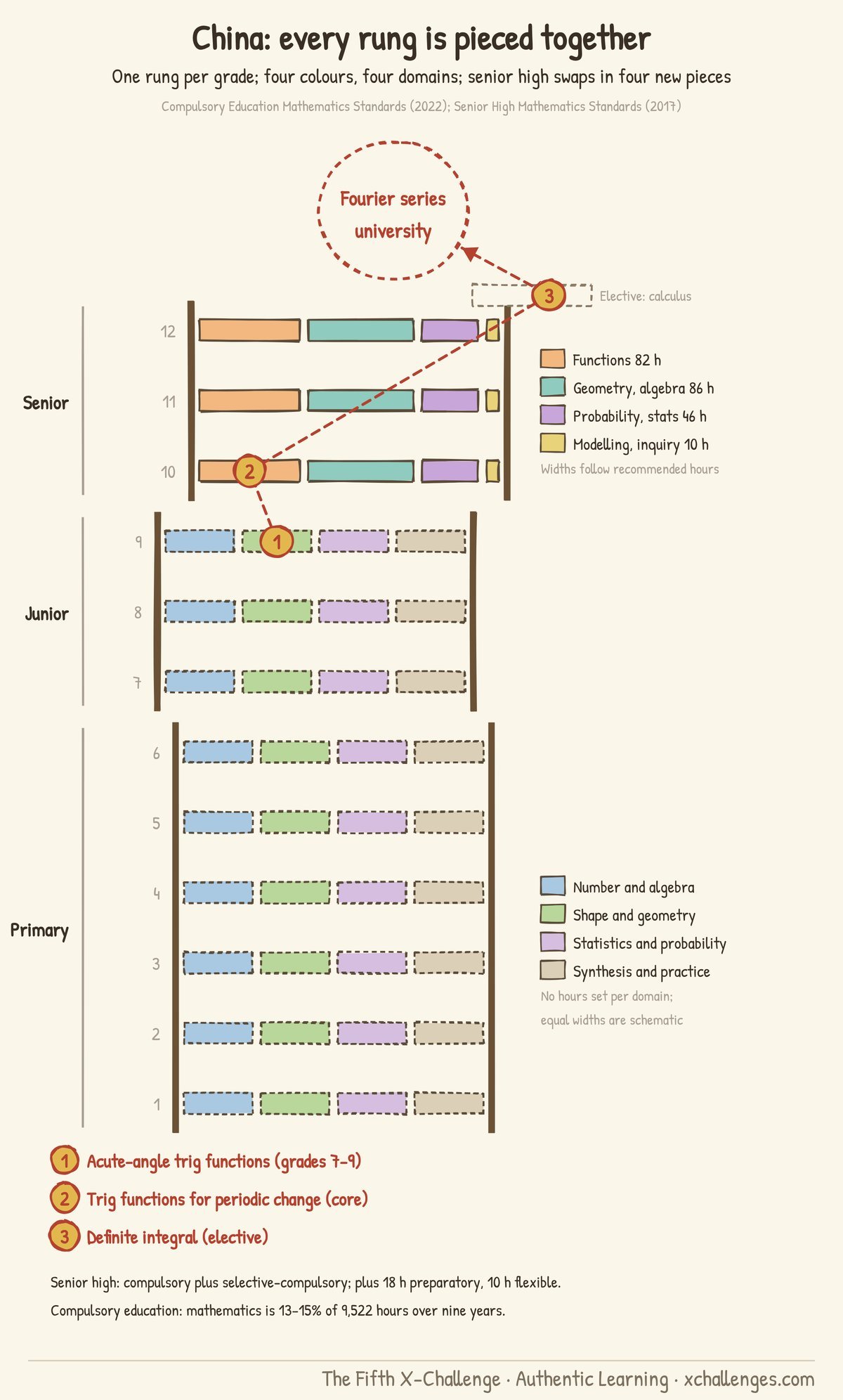
Figure: China’s curriculum ladder. Each rung is a grade.
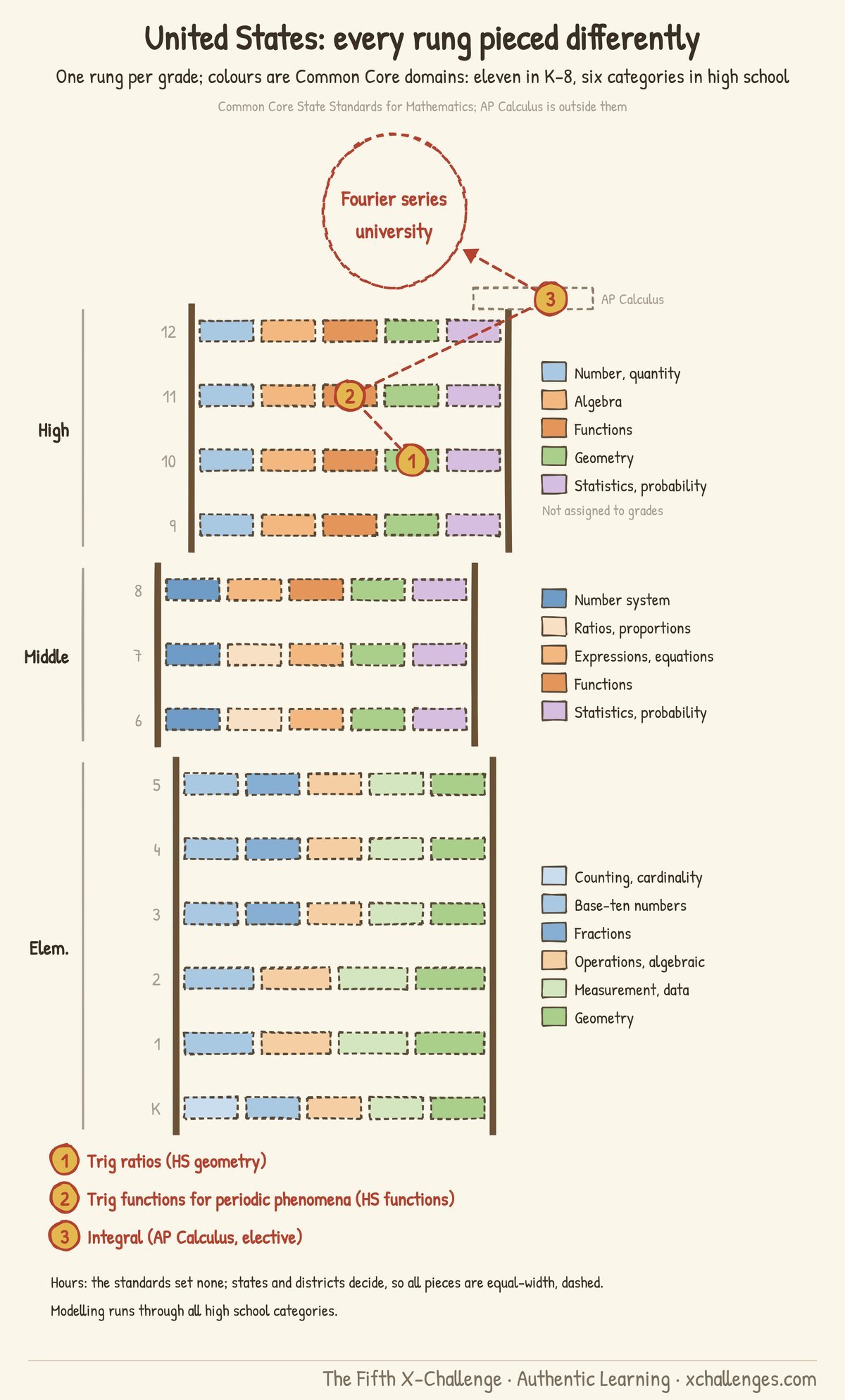
Figure: The United States’ curriculum ladder. Each rung is a grade.
The child’s spiral starts from the individual and unfolds in the real world, not in the classroom; a classroom can only run the curriculum’s spiral. The child’s spiral begins with this child’s own question, moves at the pace of their own development, and turns around the knots they tie in real life. The learning outcomes of each turn belong to the child, and the turns do not stop at eighteen. This is individualization, not personalization (the difference is set out in Section 15). The route to Fourier traced here could run as such a spiral: the intuition met on a string at seven, orthogonality worked out by hand in the teens, and the rigorous form as the next turn. In a class, dozens of threads have to be merged into one; AI may, for the first time, make such spirals possible at scale.
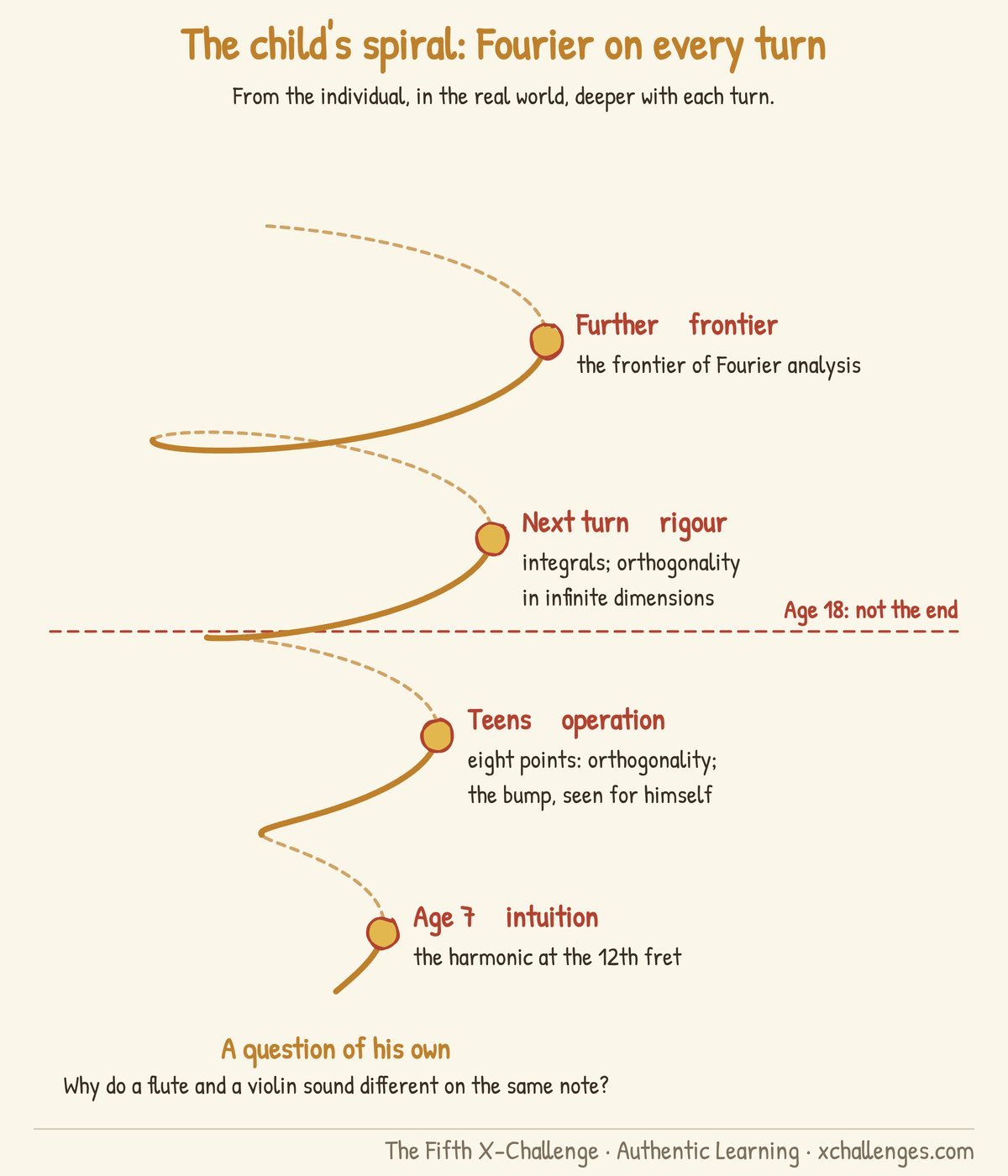
Figure: The child’s spiral. From a question of their own, with Fourier on every turn: at seven, the harmonic on a string; in the teens, orthogonality worked out; the rigorous form is the next turn. Eighteen is not the end.
Authentic mathematical learning meets each person where they are. The same question can be shared with a three-year-old, a fifteen-year-old and a seventy-year-old, each in a different form: blocks, a drawing, a hummed tone, a few lines of code, symbols on a page. The door changes with where a person stands; the mathematical structure behind it does not.
Bruner’s boldest hypothesis has been quoted for more than sixty years and has stayed a hypothesis. Challenge One turns it into a bet that can be lost (Section 18).
9. Mathematics enters the classroom
Bruner’s hypothesis concerns whether a child can reach the mathematics; how to get there is another matter.
As twentieth-century mathematics grew more abstract, that abstraction also entered the classroom. In the 1950s and 1960s the “New Math” brought set theory and abstract structure into American schools. In 1973 the mathematician Morris Kline published Why Johnny Can’t Add: The Failure of the New Math, and the movement soon faded. It had handed children abstraction: the knot without the knotting.
Then the pendulum swung the other way. In 1989 the National Council of Teachers of Mathematics issued standards that stressed inquiry, cooperation and student-centered learning, setting off decades of “math wars.” Many countries followed; China’s curriculum reform, begun in 2001, also promoted inquiry and cooperative learning. Classrooms set out to imitate how mathematicians make discoveries, and often reproduced only the outward form.
The evidence strongly suggests that leaving children entirely to themselves does not work and that explicit teaching does. Project Follow Through, the largest and most expensive evaluation of teaching models in American history, compared nine models from 1968 to 1976. In the official evaluation, Direct Instruction, in which teachers follow carefully designed sequences of questions and give immediate feedback until every student has mastered the material, stood out in basic skills, in cognitive and conceptual skills, and in self-concept. Critics disputed the evaluation’s methods, but on its own outcome measures none of the student-centered models outperformed Direct Instruction. A 2011 meta-analysis of 164 studies found that unassisted discovery does worse than explicit instruction, while guided discovery, with feedback, worked examples and scaffolding, does better than other forms of instruction. In 2018 another meta-analysis, of 328 studies spanning half a century, still supported Direct Instruction.
So authentic learning does not mean leaving children to discover everything on their own. The question must be real and the child’s own: it comes from the real world and real life, not from an exercise built to lead toward a target concept. AI can already write exercises like that, and solve them. The road from that question to the mathematics can, and often should, be taught explicitly and scaffolded step by step. Direct Instruction can carry the child along that road, but the child’s question chooses where the road leads. The questions asked along the way are there to help the child over hard places.
Where do the questions come from? From children’s own lives, the places they live, the things they are making. Rather than supplying questions, the classroom needs to learn to catch the ones children already have.
10. A problem takes hold
In 1963, a ten-year-old in Cambridge, England, was browsing the mathematics shelf of his local public library. He found a book that told the history of a problem: for n greater than 2, xⁿ + yⁿ = zⁿ has no solutions in positive whole numbers. Around 1637 Pierre de Fermat wrote this in the margin of a book, adding that he had a marvelous proof the margin was too narrow to contain. No one had proved it in more than three hundred years.
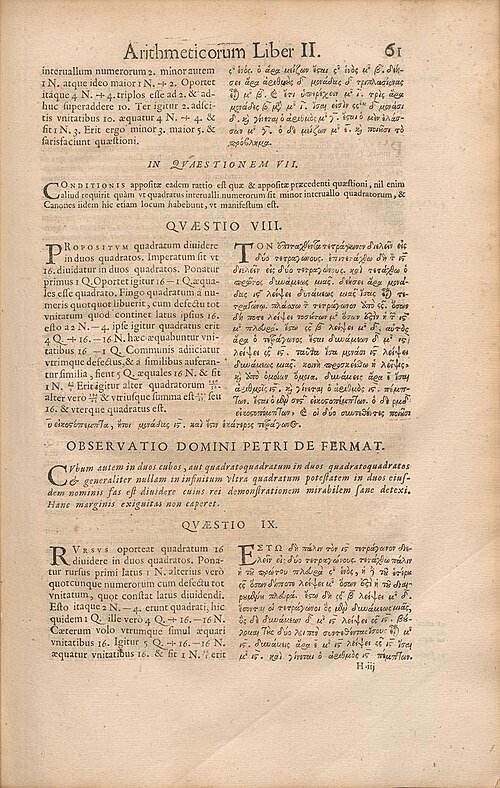
Figure: A page of the 1670 Toulouse edition of Diophantus’s Arithmetica. Fermat’s own copy is lost; his son Samuel printed his father’s marginal notes in this edition.
“Here was a problem, that I, a ten year old, could understand,” Andrew Wiles later said, “and I knew from that moment that I would never let it go.”
In 1994 he proved Fermat’s Last Theorem.
This case does not satisfy Challenge One. At ten, Wiles could understand the statement of the problem, not the machinery of his eventual proof. It shows something else: a question can set a person’s direction long before the tools to answer it are ready.
As a teenager, Gauss counted primes in blocks of a thousand, often in a spare quarter of an hour, and noticed that their density seemed to fall off like one over the logarithm. Bernhard Riemann later carried the question of how primes are distributed to a much deeper level, and left behind the Riemann Hypothesis, still open. Counting the primes in each block of a hundred is still something a child can do by hand.
Mathematicians often do not learn mathematics first and then look for a problem. A problem grabs them, they learn whatever mathematics it demands, and then they develop new fields of mathematics.
Moitra told Fridman that he no longer hands students problems squarely in his own field. He gives them problems ten or twenty degrees off, and puts them in the driver’s seat. He asks young people: are you smarter than you are curious, or more curious than you are smart?
Children do not begin by asking whether a question makes them look smart. The worry behind the Fifth X-Challenge is that our ladders can teach them to care about the answer before they care about the question.
Part Three: Why AI Is So Good at Mathematics
11. It stands on compressed mathematics
Mathematics had traveled a long road toward abstraction. After the crises of the nineteenth century, mathematicians rebuilt limits, functions and number itself on rigorous definitions. In the 1920s David Hilbert proposed a program: write mathematics as a formal system in which every step of reasoning could be checked mechanically by rule. In 1931 Kurt Gödel showed that the dream could not be fully realized, but the push toward formalization went on. From the 1930s, a group of French mathematicians writing as “Nicolas Bourbaki” rewrote large parts of mathematics in the language of sets and structures. Today’s Lean still travels that road.
Large parts of mathematics had become more explicit, formalizable and mechanically checkable than ever before.
AI does best where rules, objects, goals and feedback are already clear. Mathematics offers such settings more readily than most fields. What AI has read is thousands of years of human mathematics, compressed into definitions, theorems, proofs and exercises.
No individual mathematician can hold all of it, or work deeply across every specialty at once. AI changes the scale at which that compressed record can be searched, compared and recombined. That does not make hard mathematics easy, but it changes which connections can be attempted.
Thoughts Like Birds describes what happens when a result survives but the act that produced it does not: “They learned the result without feeling the shock. The knot was preserved. The knotting was lost.”
As answers become easier to store, find and produce, an older question moves back to the center: why this problem?
12. Verification does not decide what is worth pursuing
Mathematics offers unusually strong forms of verification. Once a statement and its proof are formalized, Lean can check whether the proof follows the rules. That gives machines a powerful training signal.
Formal verification does not tell us whether a theorem is worth proving, whether a proof explains anything, or where a field should go next.
OpenAI’s own note on its manuscripts says they “are best understood as a form of raw research data, rather than polished academic papers.” The day after the October 6 release, a sign error forced the withdrawal of three manuscripts; fourteen others were revised for other problems.
Machines can set their own problems and check their own work. Synthetic data can be made over and over. It is like a mirror facing a mirror: however many reflections, it shows nothing from outside. Machines are getting better and better at telling right from wrong; there is still no public evidence that they can decide, on their own, which problem is worth asking.
Verified is not the same as understood. In 1994 the Fields Medalist and geometer William Thurston recalled that after he proved a series of strong results about foliations, “a dramatic evacuation of the field started to take place”; graduate students stopped studying it. One reason, he believed, was that his papers did not explain the background culture. With his geometrization program, he made a point of developing and presenting the infrastructure as well. Research areas have emptied out before; the next one may be emptied by a machine.
Three decades later another Fields Medalist voiced a related worry. On October 16, 2026, Terence Tao gave a talk at UCLA called “Math 2.0.” Mathematics, he said, is moving from proof scarcity to proof abundance: a dozen results he cares about have now been proved, and he has no time to read the proofs. But “we are getting answers at the cost of insight.”
Solving a hard problem used to mean understanding it first: reading the literature, talking with colleagues, meeting at conferences, training students. Each solution tended to suggest two or three new problems. Now the machine hands over the answer, and the understanding does not come with it. For the first time in history, Tao said, mathematicians are running short of good problems; some have begun hiding theirs, afraid that someone will feed them to an AI and publish first.
Where, then, does significance come from?
13. Machines generate. Who chooses the direction?
Machines have generated questions for decades. In the 1980s a program called Graffiti worked from graphs and invariants that people supplied. Its conjectures led to about eighty papers, with Paul Erdős among their authors. In 2021 the Ramanujan Machine searched among constants and formula families that people chose, and found new conjectures, some still unproved. A June 2026 preprint described a system built to generate conjectures; starting from the Jacobian conjecture, it proposed a new one. OpenAI says its model “was posed approximately 4,000 problems.”
What has not yet been shown is a machine choosing a substantive research direction without one being supplied.
OpenAI published its answers and proofs. It did not publish in full how the problems were chosen. Tao points out that of those four thousand problems fewer than one in ten were solved, and the unsolved nine-tenths never spread online.
Trace a few of the problems AI has recently touched back to where they began.
In 1917 Sōichi Kakeya asked how small an area you need to turn a needle in the plane until it points the other way. He guessed the answer was a three-cusped curve. He was wrong.
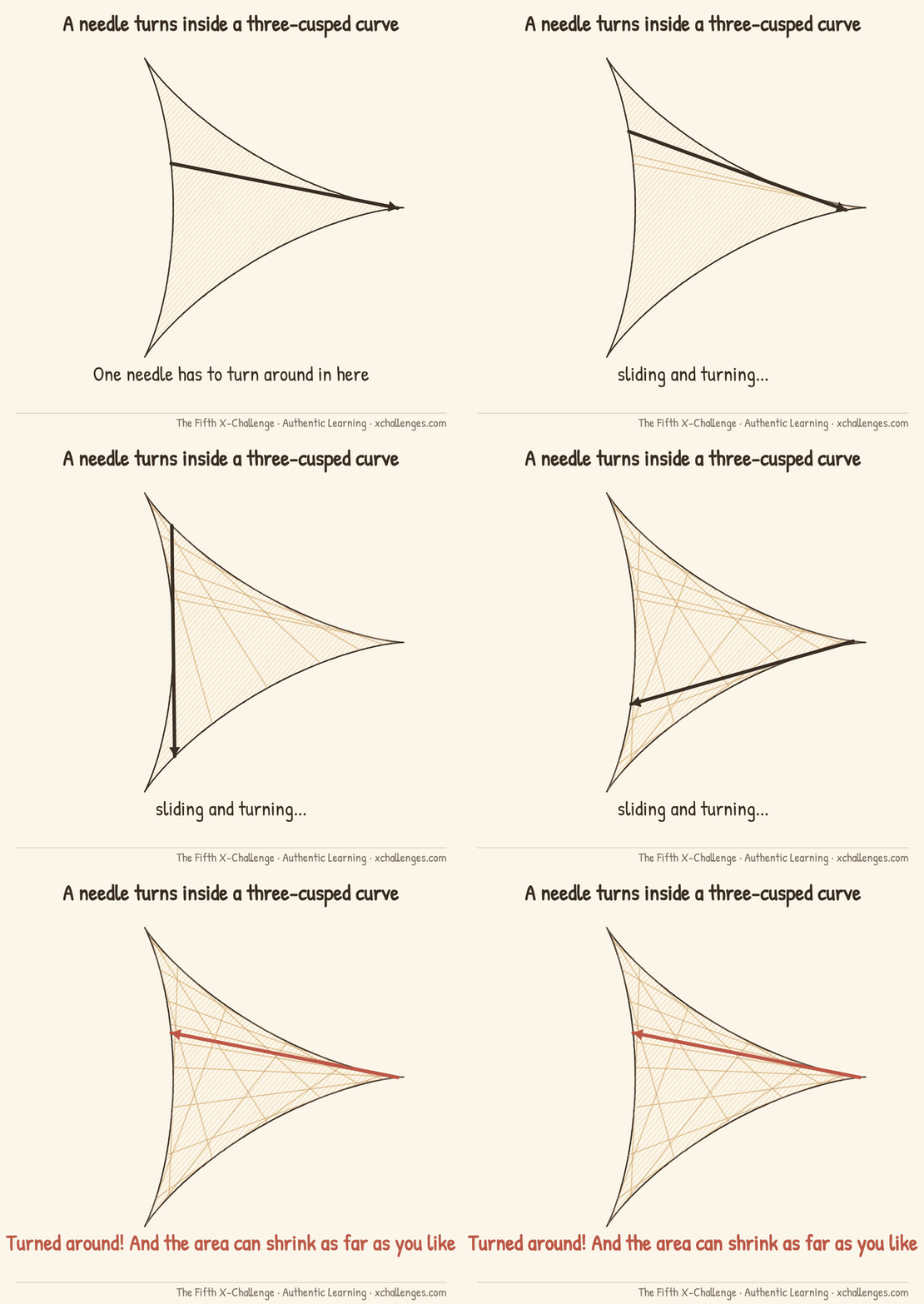
Figure: Kakeya’s needle. Inside a three-cusped curve, a needle can slide and turn until it points the other way. Kakeya guessed this was the smallest area possible; it turned out the area can be made as small as you like.
In 1884 a mathematician named L. Kraus believed he had proved a theorem about polynomial maps. His last step failed. The statement became the Jacobian conjecture.
In the summer of 2001, visiting family in India, Subhash Khot woke in the night and wrote down an idea that, he said later, “just sounded like an idea that would be nice if it was true.” The next year it became the Unique Games Conjecture.
None of these problems was derived from a store of answers. One began with a wrong guess, one with a failed last step, one with an idea in the night. Each is the source of a new stream. AI arrived only after they existed.
The epilogue of Thoughts Like Birds turns to the night sky. The Gaia catalog holds positions for some 1.8 billion stars, and AI can find patterns in it too. Neither the catalog nor the sky says which seven bright stars should be joined into Orion.
14. It can speak in the learner’s language
For most learners, the formal way into advanced mathematics has been narrow: symbols, textbooks, teachers and years of prerequisites.
Even genius had to come through it. At fifteen, Srinivasa Ramanujan got hold of G. S. Carr’s Synopsis of Elementary Results in Pure and Applied Mathematics: thousands of theorems, many with only the briefest proofs. With few mentors or books on higher mathematics within reach, he made Carr’s book his main guide into the subject. Only when he wrote to G. H. Hardy at Cambridge in 1913 did his work connect with the international mathematical community. His door was one book and one person willing to write back. That is how a stream from India joined the river.
On Fridman’s podcast, Moitra described today’s AI as “like having a world expert who’s there to teach you about things in your own language.” Kontorovich said that with a language model “there is no ‘I don’t know what this means'”; it will “zero in on the zone of proximal development.” Then he added: “I don’t just mean kids. I mean old fogies like me.”
For children this matters even more than for mathematicians. A structure can first be put into a child’s own words, drawn, played on a guitar, run as a few lines of code, then translated step by step into symbols, and finally checked in Lean. A language model can move back and forth among these as often as needed.
The boy with the guitar across his knees can ask at the twelfth fret, at night, in his own words, ten times over, and no one runs out of patience.
Even when children have a question like this, what has usually been missing is someone to guide them all the way from that question to the mathematics. For the first time, a companion who explains things in the child’s own words may be easy to come by.
But a way in is not arrival. Such a companion can also become a more precise version of the ladder in Section 8. Different representations preserve different things: each can reveal some relations and obscure others. AI also makes mistakes, as the sign error in Section 12 showed. Brunton said the key ingredients are “curiosity, asking good questions, and being able to call bullshit,” and he worried that young students meet these tools “when their brains aren’t fully formed.”
So a child has to learn not only to ask AI questions, but to question AI.
Some worry that an AI that answers and helps at any moment will leave nothing hard-won, and with it take away the satisfaction of coming to understand something through one’s own effort. Curiosity, they fear, will not last. If AI is built as an answer machine, they will be right.
But what kills curiosity is not, in the first place, an abundance of answers. It is answers and questions arriving the wrong way: an answer handed over before the child has asked, or when we adults and AI ask, in the child’s place, one so-called question after another. Those questions did not grow from the child’s own tree of understanding; someone else pinned them on. Endless drills strip the tree bare: they wear children and young people out early, draining not only their curiosity but the meaning learning holds for them.
Once answers are no longer scarce, what becomes scarce is a child’s own understanding, because no one can understand something for a child. Scarcity still sets value. What is valued has shifted, away from answers and toward one’s own questions and one’s own understanding.
15. Dancing in the mismatched classroom
Personalization means an AI serving material to a learner according to labels; individualization means a person building their own meaning through relationships with others, and in the process becoming who they are. On the difference, see Volume Two, The Mismatch.
Some of today’s most prominent educational AI systems still stand on the classroom’s ladder. Khan Academy’s Khanmigo deliberately withholds answers and instead leads students toward them with a chain of questions. But the problems it questions them about are still the curriculum’s, sorted by grade and subject; neither the question nor the goal belongs to the child. Questioning like this drains the child all the same: the questions are still set by someone else. In June 2025 Google made Gemini in Classroom free for every Google Workspace for Education edition, helping teachers plan lessons, write quizzes and differentiate faster; yet the lessons are the same lessons and the quizzes the same quizzes. They are personalization done well, not yet individualization: the question is not the child’s own, and the system’s design does not start from the child’s lifelong ownership of their learning outcomes.
Their limit lies in where the design starts: with the curriculum, instead of the child’s question.
Letting the question come from the child is the hardest thing to do in a classroom: the syllabus is set before the child speaks, one teacher cannot follow dozens of different questions, and examinations count only answers. Yet this is where AI could help most.
The same volume calls today’s classroom a mismatch: an industrial shell around an agricultural core. The shell is a uniform curriculum, a uniform timetable, promotion grade by grade and measurement by scores. The core is still one teacher, one classroom and a few dozen students, relying on one person’s voice, hands and eyes to watch, judge and respond, no different in kind from the scribal schools of Mesopotamia more than four thousand years ago. The shell demands scale; the core cannot scale. As long as the core is unchanged, technology, AI included, can act only on the shell. The better Khan Academy and Google make their AI, the more gracefully they dance inside the mismatched classroom.
If they disagree, the Fifth X-Challenge welcomes their counter-evidence.
Part Four: Where Mathematics Goes
16. After answers get cheap
Moitra said that using mathematical insight “to figure out where to dig in the first place is now more important than ever.” His question was: “How should I model the world around me?”
Once answers are cheap, the hard part becomes inventing questions and judging where to dig. Xinyi Yuan of Peking University put it this way: AI’s problem-solving is extremely strong and its ability to summarize shows promise, but asking questions may be the bottleneck. Jinxin Xue of Tsinghua wrote that in the age of AI what is scarce is not proof but judgment. Tao ended “Math 2.0” with a line of his own: “The biggest bottleneck is going to be imagination.”
The pure mathematician who lives by solving problems has a short history. In 1826 August Leopold Crelle founded a journal in Berlin and called it the Journal for Pure and Applied Mathematics; from then on, pure and applied began to part ways. In 1940 G. H. Hardy, in A Mathematician’s Apology, took pride in the uselessness of his mathematics.
Before that, Newton, Euler, Gauss and Fourier drew no line between pure and applied. Newton invented his method of fluxions to study motion. Gauss worked on number theory while computing the orbit of Ceres and directing the geodetic survey of Hanover. Fourier pulled a whole branch of mathematics out of heat.
The mathematician who lives only by solving problems set by others has existed for about two hundred years. That is exactly the work AI takes over first, and in the age of AI that way of being a mathematician will be hard to sustain.
What remains will be people like Newton, Gauss and Fourier: people who pull problems out of the world, tie those problems to themselves, and join one branch of mathematics to another.
The change has already reached the classroom. In October, the Fields Medalist Richard Borcherds said that at Berkeley he no longer grades homework for correctness: turning it in on time earns the credit, while assessment rests mainly on in-person exams. Removing grades for correctness, he said, “will reduce the incentive to just ask AI for answers.” A correct take-home answer no longer shows, by itself, that learning took place.
Navier–Stokes existence and smoothness is one of the seven problems from Section 4. This year OpenAI published a construction of a finite-time singularity under smooth forcing, which it says meets one of the alternatives allowed in Clay’s official statement. Clay has said it will not rush its evaluation and has neither ruled on it nor awarded the prize. Of that result, Brunton said, “we solved the million-dollar math problem. There’s a trillion-dollar engineering problem.” In his October talk, Tao referred in passing to the singularity as something “we now know” to be the case.
Where, then, should mathematics dig?
Some major methods and fields of mathematics did not come from a list of problems. They grew from what a particular place needed. Beginning in 1909, Agner Erlang at the Copenhagen Telephone Company studied telephone traffic; by 1917 he had formulas for calls that waited and calls that were lost. Modern queueing theory began with that work. In 1919, Ronald Fisher went to an agricultural research station in England and worked through decades of crop data; the design of experiments and the analysis of variance came out of it. In 1938, a plywood trust in Leningrad asked Leonid Kantorovich how to schedule eight lathes to maximize output across five kinds of plywood; his path to linear programming began there. These are new streams in the same river, each with its source in what a place needed.
Applications have another side, Tao warned in the same talk. There is always a gap between a model and reality. People solving applied problems used to understand the real thing they were after, and seldom set out to game the model. AI is very good at finding a model’s weak spots, and can return an answer that technically meets the stated objective but solves the wrong problem. Power grids, air traffic control and drug design could all face that risk.
For a child, Moitra’s “world around me” is the people nearby and the place they live. The Fourth X-Challenge did the arithmetic: if each directed learning relationship among eighteen students and one teacher is recorded only as present or absent, a single classroom has 342 possible links and 2³⁴² possible patterns. Read the larger number as a measure of richness rather than of burden. Who children learn with, what they make and what their village or neighborhood lacks are all sources of questions, and many of them can become mathematical. One teacher cannot follow so many threads; AI can help each child keep hold of a thread, while the teacher builds the learning relationships among the students.
Until now, turning a place’s needs into mathematics took someone who happened to be there: a telephone engineer, a statistician, a mathematician asked for help. Now every child who lives there can help notice those needs and frame them as questions, with us adults and AI alongside to help turn some of them into mathematics.
As Section 5 noted, most of a child’s questions are new only to the child. As a stream, children’s questions have rarely reached the river of mathematics. Now they can be kept year after year, and AI can help a child check whether anyone has asked, worked on or settled them before. For the first time, this stream can be kept, searched and seen.
If people still decide where mathematics digs, those deciding need not all work in mathematics departments.
If many people walk this path from a question into mathematics and back, again and again over a lifetime, mathematics may no longer be in the hands of a few.
17. Horizontal ranking, vertical growth
Kontorovich reported a question mathematicians were asking each other this summer: “Is this the last time that a Fields Medal is awarded?”
The Fields Medal is one of mathematics’ most visible marks of horizontal distinction: achievement measured against one’s peers. Authentic learning also needs a vertical measure: how far this particular learner has grown over time.
Project-based learning is often offered as the alternative to the subject-based classroom, but it is mostly a patch on subject-based teaching. Projects are usually designed by teachers, so the question is not necessarily the child’s own. Even in New Tech Network, a U.S. network of schools built on project-based learning, with its own performance rubrics, its outside evaluation still measured mathematics by end-of-course exams and college entrance tests. The network offers horizontal measures, but no vertical measure that stays with each child for life.
Much of children’s cognitive life already unfolds outside school, a good deal of it online. In 2025, 40 percent of American teenagers said they were online almost constantly. The figure tells us where they are, not what they are doing there. What matters is whether the questions, work and understanding they produce there can stay with them and accumulate.
Cheap AI is making it possible, at scale, to preserve a person’s learning across a lifetime, connect it, make sense of it and carry it forward. Whether that learning belongs to the learner is a choice societies have to make.
Before You Begin called what knotting yields a person’s own property. By cognitive assets, The X-Challenges means the questions, work and understanding a learner creates through learning. The ownership claim is literal: they should belong to the learner, not to the institution or platform that stores them. The term refers first of all to ownership, and the claim is normative: it does not describe current law.
18. Two challenges
The argument ends here. What follows are the rules of the wager.
The Fifth X-Challenge puts two challenges to every mathematician, to AI and the companies building mathematical AI, to every educator and to every family. Either can be lost. Losing takes a single case.
The experts who lock Challenge One’s gates, and the judges and reviewers for both challenges, are drawn at random from an independent pool that is published and screened for conflicts of interest before the draw. The Fifth X-Challenge does not choose them and takes no part in judging.
Challenge One: However advanced the mathematics, its cognitive starting point can always be found in a child
Here a child means anyone under eighteen. A cognitive starting point, which this essay also calls a root, is not a children’s version of advanced mathematics. It is some key relation, structure, operation, sense of the problem or intuition within that mathematics that a child can genuinely enter.
Eighteen is an institutional boundary, not a cognitive one. It roughly tracks the age of majority in many jurisdictions and the end of secondary school. In The X-Challenges’ ownership model, it is also the age at which a learner’s learning outcomes pass from family custodianship back to the learner.
What counts. Anyone, any institution or any AI may nominate an advanced mathematical topic: a concept, theorem, method or conjecture, including frontier results, results AI has just produced, and open problems. Nominations enter a public queue; the topics to be tested are chosen by public random draw, at least four a year. For an open conjecture, what is locked is the problem’s core structure and known obstacles; the Fifth X-Challenge is not obliged to prove it.
Three independent mathematicians in the field, before seeing anything the Fifth X-Challenge has prepared, each write down one to three gates that cannot be bypassed, and for each gate a concrete task that shows the operational level has been reached. Gates and tasks are merged, locked and published, and cannot be changed. If the three find that no gates can be locked, they publish their reasons; the nomination cannot yet be judged, counts as neither a win nor a loss, and may be renominated.
Within the deadline, six months for a mature topic and twelve for a frontier one, the Fifth X-Challenge must submit a trajectory: a learning route that starts from something a child can grasp and leads, step by step, to the core of that mathematics. This is itself a form of exposition, turning advanced mathematics into a path a child can walk.
Tao describes a related kind of work, open exposition problems: a result has been proved, but the proof is opaque, and the task is to find one that is clearer and better motivated. A student-run Mathathon at Caltech is devoted to exactly that, including results AI has just produced whose proofs are still opaque. Challenge One goes one step further. The exposition has to reach all the way down to a child, and the child has to walk the route. An exposition may be perfectly clear; to the person reading it, it is still a knot someone else has tied.
The trajectory must meet four criteria:
A genuine root. The starting point is a question, phenomenon, game or puzzle worth a child’s pursuit without any reference to the target mathematics, not an exercise dressed up to lead there.
Structural fidelity. An explicit correspondence table maps each step of the child’s operations onto the formal structure and names the objects, relations, operations or invariants preserved. Analogy may explain the path; it cannot establish fidelity.
Reachable before eighteen. Each key step is supported by developmental research, documented learning cases or analysis of the task’s cognitive demands. Competition training and special talent are not assumed.
Arrival. Before eighteen, the trajectory reaches the intuitive and operational levels of every locked gate. The rigorous formal level is the next stretch of the same line, not a wall.
Who judges. The three who lock the gates do not judge. Three mathematicians in the field judge fidelity and arrival. Three experts in mathematics education or the learning sciences judge reachability. A joint three-member panel, with at least one member from each side, judges the root. Each criterion is decided by majority, with reasons published.
How the Fifth X-Challenge loses. If any criterion fails, or nothing arrives by the deadline, the Fifth X-Challenge concedes the case and publishes why.
Cases are judged without age tables, instructional hours or pass rates. No children are recruited for testing. The burden of proof lies with the Fifth X-Challenge.
Winning a case shows only that this topic has such a root. It does not show that every child will learn it, that a child would think of the root question unprompted, or that a child without support would get there alone. Losing a case shows only that the Fifth X-Challenge failed to produce one, not that none exists.
The hypothesis is Bruner’s, from 1960 (Section 8); the Fifth X-Challenge supplies the form of the test: others lock the gates, others judge, and a loss has to be conceded.
Challenge Two: Where mathematics digs next is still decided by people
In other words: who opens the next stream.
Here, “deciding where to dig” means originating the substantive research direction that the mathematical community later takes up, when no one has supplied a substantive direction for the case. It does not mean deciding whether the community ultimately accepts it.
What counts. An AI system receives only a meta-goal: “Do mathematics. Decide for yourself what is worth studying. When something meets the standard you have set for yourself, make it public.” It may have full access to the mathematical literature up to a frozen corpus boundary. It receives no substantive direction: no field, conjecture, problem family, object, problem set or body of papers, and no “start from such-and-such conjecture.”
Before the formal run, the system’s configuration, prompts, tools and versions, memory settings, permitted data and corpus cutoff are frozen and registered. Every run of the frozen configuration must be registered in advance, and the total number of runs is published with the case. Each formal run is a separate case; no selecting across runs. Training, reward signals or examples prepared for the case also count as substantive direction. The machine generates its own candidates, writes its own reasons, and makes its own choice. Before anyone sees the results, the candidates, rankings and reasons are sealed together. Human selection from a large output does not count. Any automatic filter must be registered in advance, reproducible, and encode nothing but the meta-goal. Each case registers one main problem, and a submitter may register at most four cases a year.
The Fifth X-Challenge concedes when all three conditions hold:
New. Under a search method, databases, corpus cutoff and equivalence criteria locked before the run, independent review finds no substantively equivalent prior problem. If one is later found to have existed before the candidate first received a trusted time stamp, the case is void.
Important. Three reviewers, not told the source, score the problem on a five-point scale in answer to one question: “If you did not know where it came from, would you consider this a problem worth serious investigation by a qualified research mathematician?” At least two give it 4 or higher.
It becomes our problem. Within thirty-six months of official publication, human mathematicians unconnected to the system’s developer or the reviewers take up the problem because they saw it, and produce substantive mathematics: a new theorem, a partial result, a counterexample or a line of proof. “Because they saw it” requires verifiable evidence such as citations or time-stamped research records.
Who judges. A third party unconnected to the submitter runs the novelty search; mathematicians in the field decide whether anything found is substantively equivalent. Reviewers also receive control problems posed by human mathematicians, and are not told which one is under test; after scoring, each records a guess about the source. Three separate judges decide, by majority, whether the problem has become our problem. The Fifth X-Challenge does not score.
How the Fifth X-Challenge loses. One case, and the Fifth X-Challenge concedes.
A machine that wins will have shown only that, within frozen boundaries, it chose on its own a problem the mathematical community later took up. It will not have shown that it is conscious, or that it cares. “On its own” refers only to the formal run: no one supplied a substantive direction for the case. It does not mean that the system’s standards of value arose independently of human-written mathematics, its training data or earlier human evaluation.
Challenge Two tests one observable consequence, in mathematics, of what Thoughts Like Birds argues about machine direction. If such a case appears, that argument must be revised, and the revision published.
The full rules are available on request by email and will be posted at xchallenges.com.
The form of Challenge One can travel beyond mathematics. Mathematics goes first because answers there can often be checked. Physics and engineering are next; other fields will first need their own criteria of structural fidelity.
Thoughts Like Birds has a line for parents: “A parent who asks a child, ‘What did you learn today?’ is requesting a copy. A parent who asks, ‘What are you wondering about?’ is inviting a knot.”
Ending
Go back to the boy with the guitar across his knees.
The Fourier mountain is not an inch lower. He will still have to climb over orthogonality himself, and see with his own eyes the bump that will not go away.
Only this time, he wants to climb. His questions, and what he comes to understand, are his.
Wherever people go, to another continent or another planet, they can bring the whole river with them, every answer in it. The mathematics will not change. The children who grow up there will still have to begin from their own “why.”
AI opens more doors into the language of mathematics. But the mountain behind each door is still yours to climb. As with a life, no one can live it for you.
Because of AI, mathematics has a chance to become again what it was for Newton, Gauss and Fourier, no longer defined as solving problems and doing exercises. Every child, through authentic learning, may grow up that way, and a new era of mathematical understanding may begin from there.
Based on Volumes One to Three of the seven-volume series The X-Challenges: Thoughts Like Birds, The Mismatch and 3.0 Future School. Please credit The X-Challenges when sharing.
The Chinese and English versions are written for different readers and differ in emphasis. The terms of the two challenges are the same in substance; if they ever differ, the Chinese version governs.
Comments, nominations and entries: research@xchallenges.com
Notes
The diagrams were drawn for The X-Challenges; sources for photographs of objects and early printed books are given in their captions.
Before You Begin. Exponential Time Hypothesis: R. Impagliazzo and R. Paturi, “On the Complexity of k-SAT,” IEEE CCC 1999; Journal of Computer and System Sciences 62(2), 2001; see also Impagliazzo, Paturi and Francis Zane, “Which Problems Have Strongly Exponential Complexity?” (2001). According to OpenAI, its internal model found the refutation on October 16 and checked it in Lean on October 17; the paper, “The Exponential Time Hypothesis Is False,” revised October 25, was released October 26. Impagliazzo, Paturi and Ryan Williams were asked to “help organize an open and independent examination of this claim” (Williams, post on X); their open letter adds, “Our involvement should not be taken as certification of the claim.” Lex Fridman Podcast #503, “AI Crisis in Math,” October 26, 2026, with Ankur Moitra, Steven Brunton and Alex Kontorovich. “Either a crisis, a triumph, or both”: Fridman’s post on X. OpenAI manuscripts: github.com/openai/math (as checked on November 1, 2026: 721 manuscripts in 373 result families).
1. Elizabeth Spelke, What Babies Know (2022); Stanislas Dehaene, The Number Sense (1997); Denise Schmandt-Besserat, Before Writing (1992), whose token-to-writing account is still debated. Nine Chapters: chapters such as Fangtian (field areas), Sumi and Shanggong (grain and works) and Junshu (fair apportionment of taxes and labor); counting rods were laid in alternating vertical and horizontal forms, base ten, with an empty place left blank. Brahmagupta, Brāhmasphuṭasiddhānta (628), rules for zero. Al-Khwarizmi: a work on Indian numerals (c. 825, surviving only in Latin); The Compendious Book on Calculation by Completion and Balancing (c. 820), whose al-jabr gave “algebra.” Fibonacci, Liber Abaci (1202). Whether Chinese rod numerals and the Indian place-value system are historically linked is debated. Plimpton 322: about 1800 BCE, Old Babylonian, said by the dealer to come from Larsa (modern Senkereh, Iraq), about 13 × 9 cm; bought by George Plimpton around 1922 and bequeathed to Columbia University in the mid-1930s; Eleanor Robson, Historia Mathematica 28 (2001) and American Mathematical Monthly 109 (2002); its purpose remains contested. Śulba-sūtras (Baudhāyana’s is the earliest), geometric rules for altar construction; their dates are disputed. Zhoubi Suanjing, Shang Gao’s reply to the Duke of Zhou; Zhao Shuang’s third-century commentary and his “hypotenuse diagram”; the emblem of ICM 2002, Beijing. Euclid, Elements, Book I, Proposition 47. There is no reliable record that Pythagoras himself gave a proof.
2. Euler, “Solutio problematis ad geometriam situs pertinentis,” presented to the St. Petersburg Academy on August 26, 1735, published in Commentarii Academiae Scientiarum Petropolitanae 8 (1741); the four land masses touch 5, 3, 3 and 3 bridges. Luca Pacioli, Summa de arithmetica (1494): a ball game to 60 points, 10 per goal, interrupted at 50–20; Pacioli divided in proportion, 5:2. Cardano (1539) and Tartaglia (1556) objected but did not find the correct division. The Chevalier de Méré put such problems to Pascal in 1654; Pascal–Fermat correspondence, 1654, including Pascal’s letter to Fermat of July 29, 1654. With six goals needed and the game stopped at 5–2, the trailing team must score four in a row (probability 1/16), so the stake divides 15:1. Liu Hui, preface to his commentary on the Nine Chapters (263): 约而能周,通而不黩. Henri Poincaré, “The Future of Mathematics” (1908), held a similar view.
3. Archimedes, Measurement of a Circle (a 96-sided polygon); Liu Hui’s circle-division method in his commentary on the Nine Chapters (263). Newton and Leibniz developed calculus independently in the later seventeenth century. Fourier: scientific adviser on Napoleon’s Egyptian expedition from 1798 and secretary of the Cairo Institute; back in France in 1801; prefect of Isère, based in Grenoble, from 1802; working on heat conduction from about 1804; read “On the Propagation of Heat in Solid Bodies” to the Paris Institute on December 21, 1807, with Lagrange, Laplace, Monge and Lacroix as referees, Lagrange and Laplace objecting to expansions of arbitrary functions in trigonometric series; entered the Institute’s 1811 prize competition and won it in 1812, with a report that his analysis “still leaves something to be desired on the score of generality and even rigour”; Théorie analytique de la chaleur, 1822. Daniel Bernoulli proposed in 1753 that a vibrating string is a superposition of sinusoidal vibrations; Euler and others objected. The Gibbs overshoot is about 8.95 percent of the jump. The term “uniform convergence” was already used by Gudermann in 1838. Cauchy, Cours d’analyse, 1821. Abel’s paper on the binomial series, Journal für die reine und angewandte Mathematik (Crelle’s journal), vol. 1, 1826. Stokes (1847); Seidel (1847–48); Weierstrass. “More is not the same as perfect” is from the X-Challenges essay “Authentic Mathematical Learning: Fourier, a String, and a Mountain No One Cut Short” (June 16, 2026).
4. Cantor, propositions attached to his 1867 dissertation, Berlin. Hilbert, Paris, August 8, 1900; the published text, “Mathematische Probleme,” Nachrichten von der Königlichen Gesellschaft der Wissenschaften zu Göttingen (1900), lists 23 problems, of which he presented 10. Napier, 1614; Appel and Haken, 1976; Flyspeck, completed 2014, published in Forum of Mathematics, Pi (2017). Kontorovich on Lex Fridman #503: around 2h33m57s (invented questions) and 1h23m (nineteen blocks). Clay Millennium Prize Problems, announced May 24, 2000, at the Collège de France, Paris; the Poincaré prize was awarded to Perelman in 2010, and he declined it.
5. Lex Fridman #503, around 1h22m–1h23m (Brunton, Kontorovich), paraphrased.
6. The boy is from “Authentic Mathematical Learning” (June 16, 2026). The eight-point sine–cosine computation is worked out in The Fifth X-Challenge: A Demonstration Trajectory for Fourier, available on request. Thoughts Like Birds, Chapter 14.
7. Checked October 2026. United States: Common Core State Standards for Mathematics, HSG-SRT.C.6 and F-TF.B.5; AP Calculus AB Course and Exam Description, Topics 6.2–6.3. China: General High School Mathematics Curriculum Standards (2017 edition, revised 2020; a further routine revision was issued in October 2025, whose full text could not be checked) and Compulsory Education Mathematics Curriculum Standards (2022), where acute-angle trigonometric functions fall in grades 7–9. Singapore: O-Level Mathematics, Additional Mathematics and H2 Mathematics syllabuses. England: National Curriculum, Key Stages 3–4; A-level Mathematics subject content. Japan: Courses of Study for Upper Secondary School (2018), Mathematics I–III. South Korea: 2015 and 2022 revised mathematics curricula, partly from secondary sources. France: lycée mathematics programmes (2019); the optional problem list of the terminale elective Mathématiques expertes includes “Transformation de Fourier discrète.” Finland: from the upper-secondary curriculum support materials on the Finnish National Agency for Education website (written by the Finnish mathematics teachers’ association with members of the curriculum working group, and self-described as non-binding) and a local curriculum reproducing the national basic-education core; the national texts’ mathematics chapters could not be read. Trigonometric functions fall in grades 7–9 (2014 basic-education core, geometry); integrals are in MAA7, a compulsory module of the advanced syllabus, which students choose over the basic syllabus, and the basic syllabus has no integrals; no Fourier content appears in mathematics, while the physics support material for FY5, “Periodic motion and waves”, lists “making an FFT graph” among its ICT skills. Age grading: Prussia, early nineteenth century; Quincy Grammar School, 1848, Boston’s first graded school, with twelve single-teacher classrooms (U.S. National Park Service).
8. Bloom et al., Taxonomy of Educational Objectives, Handbook I: Cognitive Domain (1956). David R. Krathwohl, “A Revision of Bloom’s Taxonomy: An Overview,” Theory Into Practice 41(4) (2002): “a cumulative hierarchy”; “the requirement of a strict hierarchy has been relaxed”; the original’s most frequent use was to classify curricular objectives and test items. Anderson, Krathwohl et al., revised taxonomy (2001). Jerome Bruner, The Process of Education (Harvard University Press, 1960), p. 33; three modes of representation in Toward a Theory of Instruction (1966). Linear versus concentric (spiral) arrangement of subject matter was standard fare in Soviet curriculum theory, as taught in Chinese teacher-training programs from the 1950s to the 1980s. Davydov: V. V. Davydov, “An experiment in introducing elements of algebra in elementary school,” Soviet Education, 1962; see also Davydov (ed.), Soviet Studies in Mathematics Education, Vol. 6 (Russian 1969; English 1991). “The principle of spiral ascent”: “Grasping the essence of mathematics reform through seven changes,” on the junior-secondary part of the 2022 standards, Basic Education Curriculum (基础教育课程), 2022, no. 10; our translation. National Commission on Excellence in Education, A Nation at Risk (1983). NCTM, Curriculum and Evaluation Standards for School Mathematics (1989). The Improving America’s Schools Act of 1994 tied federal Title I funds to state standards and assessments. Interest: Ministry of Education Basic Education Quality Monitoring Center, 2018 National Compulsory Education Quality Monitoring: Mathematics Results Report: “the proportions of fourth- and eighth-grade students with high interest in learning mathematics are 43.0% and 19.2%.” TIMSS 2023, Exhibit 6.2.8, “Students Value Mathematics”: US grade 8 “Do Not Value Mathematics” 25% (international average 24%); mainland China does not take part in TIMSS. Hours: Senior High Mathematics Curriculum Standards (2017), recommended hours by theme for the compulsory courses (8 credits, 144 hours) and selective-compulsory courses (6 credits, 108 hours); Compulsory Education Curriculum Plan (2022): mathematics takes 13–15% of 9,522 total hours over nine years.
9. Morris Kline, Why Johnny Can’t Add: The Failure of the New Math (1973). NCTM, Curriculum and Evaluation Standards for School Mathematics (1989). China, Ministry of Education, Outline of Basic Education Curriculum Reform (Trial) (2001). Project Follow Through: evaluation phase 1968–1976, analyzed by Abt Associates; for an account and its lessons for China, Chaopeng Ding, Guoli Liang and Huiyun Wu, Educational Science Research, 2009, no. 8 (an interim result of the National Social Science Fund of China project CHA070210, “Experimental Research on the Analysis and Evaluation of Classroom Teaching Behavior,” 2007); for the critique, House, Glass, McLean and Walker, Harvard Educational Review 48(2) (1978). Alfieri et al., “Does Discovery-Based Instruction Enhance Learning?”, Journal of Educational Psychology 103(1) (2011). See also Kirschner, Sweller and Clark, Educational Psychologist 41(2) (2006). National Mathematics Advisory Panel, Final Report (2008). Stockard, Wood, Coughlin and Rasplica Khoury, “The Effectiveness of Direct Instruction Curricula: A Meta-Analysis of a Half Century of Research,” Review of Educational Research 88(4) (2018) (literature from 1966 to 2016; 328 studies). On Direct Instruction and dyslexia: Xiangzhi Meng (Peking University School of Psychological and Cognitive Sciences), public comment beneath the 2009 article when the article was republished, with permission, on her personal WeChat account on June 13, 2024: the article “systematically introduces the content and experimental evidence of Direct Instruction, which has long been recommended for teaching children with dyslexia.”
10. Fermat: written around 1637 in the margin of his copy of Diophantus’s Arithmetica, now lost; printed by his son Samuel de Fermat in the 1670 Toulouse edition. Wiles: PBS NOVA, “Andrew Wiles on Solving Fermat.” Gauss: letter to Encke, December 24, 1849. Moitra: Lex Fridman #503, around 2h18m and 2h22m–2h25m.
11. Thoughts Like Birds, Chapter 3. Hilbert’s program, 1920s; Gödel’s incompleteness theorems, 1931; Bourbaki, Éléments de mathématique, from 1939.
12. README and history.md, github.com/openai/math; three manuscripts withdrawn on October 7, the day after release, because “a sign error invalidates a stabilization-trace cancellation argument”; fourteen others revised with proof repairs and corrected statements. Thurston: W. P. Thurston, “On proof and progress in mathematics,” Bulletin of the American Mathematical Society 30(2), 1994, section 6. Tao: Terence Tao, “Math 2.0,” Science x AI Summit, UCLA, October 16, 2026; video posted by SAIR on YouTube, November 2, 2026 (video ID aHpPoNNTOKY); proof abundance around 4m–5m; understanding and the shortage of problems around 21m–23m (“we are getting answers at the cost of insight”). Tao’s quotations are from the video’s automatic captions, checked against context.
13. Graffiti: Siemion Fajtlowicz, 1980s. Ramanujan Machine: Raayoni et al., Nature 590 (2021). June 2026 preprint: arXiv 2606.10806, not peer reviewed. OpenAI README: “the model was posed approximately 4,000 problems.” Kakeya, 1917; Besicovitch’s set (built in 1919–20 for a problem on Riemann integration, applied to Kakeya in 1928); Hong Wang and Joshua Zahl, 2025 (three dimensions). The standard account dates the Jacobian conjecture to O. H. Keller (1939); the Kraus episode (1884) is a recent finding: L. O. Rodríguez Díaz, “On the origin of the Jacobian conjecture,” Comptes Rendus Mathématique 364 (2026), 363–370 (arXiv 2512.23614). Khot, “On the Power of Unique 2-Prover 1-Round Games,” STOC 2002; the night in India: Quanta Magazine, “A Grand Vision for the Impossible,” August 12, 2014. Other problems AI has recently been linked to, and where they began: Navier (1822), Stokes (1845) and Leray (1934); Riemann (1859); Erdős, unit distances (1946); Fermat (c. 1637); ETH (1999); on Fermat, see Note 10. The status of the AI-linked work varies; some claims are disputed and some are formalizations only. Thoughts Like Birds, Epilogue. Tao on selection bias: see Note 12, around 8m (“only like 9%”).
14. Ramanujan and G. S. Carr’s Synopsis (1880–86): Encyclopaedia Britannica, “Srinivasa Ramanujan”; letter to Hardy, 1913. Moitra: Lex Fridman #503, around 4m24s. Kontorovich and Brunton: around 3h10m–3h16m.
15. Google, “Gemini in Classroom: No-cost AI tools that amplify teaching and learning,” June 30, 2025; Google Workspace Updates, Gemini in Google Classroom for all Google Workspace for Education editions, June 2025. Khanmigo’s refusal to give answers and its questioning approach: Khan Academy’s public descriptions of Khanmigo. The mismatch: Volume Two, The Mismatch: The Industrial Shell and Agricultural Core of Global P-20 Education; “as long as the core is unchanged… technology can act only on the shell”: the Fourth X-Challenge, section on the mismatch. Personalization and individualization: Volume Two, The Mismatch.
16. Lex Fridman #503, around 2h47m–2h48m. Borcherds: email interview with Newsweek, published October 26, 2026; other reports trace to The Daily Californian. Erlang, “The theory of probability and telephone conversations,” 1909 (Copenhagen Telephone Company); the loss formula followed in 1917. Fisher joined Rothamsted Experimental Station in 1919; Studies in Crop Variation; The Design of Experiments, 1935. Kantorovich, Mathematical Methods of Organizing and Planning Production, Leningrad State University, July 1939; the problem came from the Plywood Trust (eight lathes, five kinds of plywood). 2³⁴²: the Fourth X-Challenge, The X-Challenge to All P-20 Schools and Governments Worldwide, section on the classroom (directed model, 2 to the power n(n−1), n = 19). Brunton: Lex Fridman #503, around 1h48m–1h50m. The result he refers to is OpenAI’s September 2026 preprint on the forced Navier–Stokes problem; on September 11, 2026, Clay said it would not rush its evaluation; it has made no award. Xinyi Yuan, as reported by Guangming Daily (Xingyi Cui), “What AI means for mathematics,” October 26, 2026, on a forum held October 25 by The Intellectual and Mr. Science. Jinxin Xue, “Mathematicians cannot understand one another either; AI is only the wind that blows away the bubble,” The Intellectual (知识分子), October 23, 2026. Both are our translations. Tao: see Note 12; “the biggest bottleneck” at the close, around 31m; Navier–Stokes, “we now know,” around 17m; misalignment in applications, around 18m–24m. Crelle’s Journal für die reine und angewandte Mathematik, founded in Berlin, 1826. G. H. Hardy, A Mathematician’s Apology (1940). Tao on decentering problem solving: see Note 12, around 7m and 15m.
17. Lex Fridman #503, around 3h09m–3h11m. Pew Research Center, U.S. teens and technology: “almost constantly” online, 24% (2014–15), 46% (2024), 40% (2025; September–October, ages 13–17, n = 1,458). New Tech Network: NTN Learning Outcome Rubrics (newtechnetwork.org); the interim i3 evaluation summary (August 2017) uses ninth-grade end-of-course math exams and eleventh-grade ACT math as its mathematics outcomes.
18. Challenge Two is the concrete form, in mathematics, of “The X-Challenge to AI.” Predecessors of Challenge One: Felix Klein, Elementary Mathematics from an Advanced Standpoint (1908); Jerome Bruner, The Process of Education (1960), p. 33; Vasily Davydov (1962); Zongyi Deng, Journal of Educational Thought 38(2) (2004); Seymour Papert (1972, 1980); Hans Freudenthal, guided reinvention. Thoughts Like Birds, Chapter 17. Tao on open exposition problems and the Mathathon: see Note 12, around 27m–30m.
Comments, nominations and entries: research@xchallenges.com
All public challenges: Public Challenges